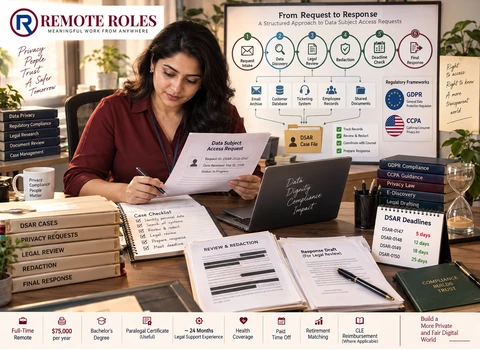
Somewhere in a company inbox right now, someone might already be waiting on an answer to a fairly reasonable question: what personal data does this company actually have on me? Under privacy laws like the GDPR and CCPA, that question comes with a legal deadline attached, and this role exists to make sure the answer goes out accurate, complete, and on time.
What a normal week looks like
You will draft and review the documents that go into a data subject access request response, conduct research to confirm what personal data exists across different systems, and organize the resulting case files so nothing gets lost between intake and delivery. Coordinating with attorneys or in-house counsel runs through the work constantly, since almost every request eventually needs a legal sign-off before it goes out the door.
- Draft and review documents responding to data subject access requests, working from company systems and records
- Conduct legal research to confirm applicable requirements under relevant privacy regulations for each request
- Organize and maintain case files so every request stays traceable from intake through final response
- Track statutory deadlines for each request and escalate anything at risk of running late
- Coordinate with requesters, internal teams, and outside parties such as vendors or data processors to gather complete records
- Support attorneys and in-house counsel by preparing summaries and flagging anything unusual before final review
A single request can touch half a dozen systems: an email archive, a customer database, an old ticketing platform nobody quite decommissioned. Part of the job is knowing where personal data actually tends to hide inside a company's systems, not just where the official records say it should be, and that instinct is usually what separates someone fast at this from someone who is merely thorough.
The volume of requests varies by client and by season, with noticeable spikes after a company sends a marketing campaign, changes its privacy policy, or shows up in the news. Some weeks bring a handful of routine requests that move through the process cleanly. Others bring a batch of unusually complex ones, perhaps a former employee asking about years-old records, or a request that overlaps with active litigation and needs an extra layer of legal review before anything goes out.
Redaction is a quiet but constant part of the work. A file pulled to answer one person's request almost always contains other people's personal information mixed in, an email thread with several participants, a shared document with unrelated notes, and part of the job is separating what belongs in the response from what does not, carefully enough that nothing sensitive slips through by accident.
Who fits this role
A bachelor's degree is the baseline education requirement, and a paralegal certificate on top of it is a common, and genuinely useful, addition. Most candidates bring 24 months in a law firm or a legal support role, even if it was not privacy-specific before now. What actually predicts success here is less about a particular credential and more about comfort with process: following a checklist precisely, keeping records organized under a deadline, and not losing track of a request just because three others came in the same week.
People coming out of paralegal work, litigation support, or general legal administration tend to find the transition into this specialty straightforward, since the research and document-handling instincts carry over directly even if the specific subject matter, privacy law, is new to them.
The team you would join usually includes in-house counsel, a privacy lead, and one or two other specialists handling the same queue, with clear ownership over which requests belong to whom so nothing falls between two people who each assumed the other had it. Regular syncs cover anything ambiguous, while routine requests move through without needing a meeting at all.
New specialists usually start on more straightforward requests, employment verification style inquiries or requests from current customers with simple system footprints, before taking on the more complicated ones involving former employees, litigation holds, or requests that touch several business units at once. That progression tends to happen within the first couple of months rather than dragging out.
Requesters themselves range widely, current employees, former ones, job applicants who never got hired, and customers who simply want to know what a company has on file about them. Each category tends to carry slightly different system footprints and expectations, and specialists who learn those patterns quickly tend to move through their queue with fewer surprises.
Skills and tools
- Legal research
- Document drafting and review
- Case management software proficiency
- Strong attention to detail under deadline pressure
On the nice-to-have side, prior experience specifically with data subject access requests or privacy compliance stands out, along with familiarity with GDPR, CCPA, or similar frameworks, e-discovery or document review platform experience, and paralegal certification where you do not already have one.
Pay and benefits
The role pays 75,000 dollars a year on a full-time basis, and it is one of the more privacy-specific legal support postings Remoteroles carries, reflecting how much this kind of work has grown as more jurisdictions pass their own data protection laws.
- Health coverage
- Paid time off
- Retirement plan matching
- Continuing legal education (CLE) reimbursement where applicable
How remote works day to day
The work runs on deadlines rather than a clock, which suits a remote setup well. Case management software keeps every request visible to the whole team, so coordination happens through shared files, comments, and scheduled check-ins rather than someone needing to be reachable every hour. Some overlap with standard business hours helps when a request needs a same-day answer from counsel, but the bulk of the research and drafting work can happen on a schedule that fits the person doing it.
Specialists who spend a couple of years building depth in this area often move toward broader privacy program roles or a paralegal specialization in data protection, since the deadline discipline and cross-system research skill built here transfers well into either direction.
To apply, send a resume along with any experience you have in legal support, privacy work, or document-heavy compliance roles. Candidates who move forward typically complete a short written exercise before a final conversation, and most hear back within two to three weeks.