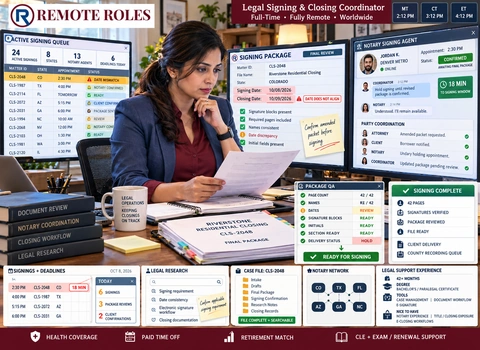
One signature landing in the right place at the right time can matter more than people outside a busy title company or law office ever realize, and this role sits right at that pressure point. You will coordinate a roster of notary signing agents, keep legal documents moving cleanly through review, and make sure nothing slips through the cracks between a signed contract and a closed file.
The position is full-time and fully remote, and since the team works with clients and outside parties across many states and time zones, you can be based anywhere in the world, as long as your working hours overlap enough to keep signings on schedule. There is no physical office attached to this job and no specific city or country requirement, so you will set up your own workspace and build a rhythm that works for you.
Day to day, you are the person attorneys and in-house counsel lean on to keep everything organized. You draft and review documents, dig into legal research whenever a question comes up mid-case, and keep case files clean enough that a colleague could pick one up without needing to ask you where anything is. A fair amount of the job is quiet, careful work that only gets noticed when it is missing.
What you will handle
- Draft, proofread, and revise legal documents tied to signings, closings, and active case files, flagging anything that looks off before it becomes a real problem.
- Conduct legal research to support attorneys and in-house counsel whenever a question comes up during an active matter.
- Organize and maintain case files so records stay accurate, complete, and easy for anyone on the team to find quickly.
- Track deadlines across multiple signings and matters at once, sending reminders before anything is genuinely at risk of slipping.
- Coordinate directly with clients, notary signing agents, and outside parties to schedule and confirm appointments.
- Review completed signing packages for compliance before they go back to the client or get filed with the county recorder.
- Step in when something goes sideways, like a borrower who wants to reschedule twenty minutes before a signing, and get the right person looped in fast.
- Maintain a shared calendar of upcoming signings and deadlines that the rest of the team can rely on without double-checking it themselves.
We are looking for someone with a bachelor's degree as the baseline, though a paralegal certificate paired with solid legal support experience is also a fine path into this role. Beyond that, you should have around 42 months of hands-on experience in a law firm or legal support setting, enough time to have watched a signing go wrong once or twice and learned how to fix it calmly instead of panicking about it.
What you will bring
- Strong legal research skills and genuine comfort digging through statutes, forms, or precedent when a question comes up.
- Confident document drafting, with an eye for the kind of small wording error that causes a much bigger headache later on.
- Working knowledge of case management software, or the ability to pick up a new system quickly without much hand-holding.
- Sharp attention to detail, especially once deadlines start stacking up in the same week.
Nice to have
None of the following is required, but each one shortens the ramp-up considerably if you already have it.
- Prior experience specifically coordinating notary signing agents or a network of mobile notaries.
- Familiarity with e-closing platforms or electronic signature workflows.
- A notary commission of your own, even though it is not required to hold this seat.
- Exposure to title insurance or mortgage closing timelines specifically, rather than general litigation support.
Remoteroles lists this position on behalf of a legal support employer that runs a fully distributed coordination team, so you will mostly interact with colleagues through chat, video calls, and a shared document queue rather than a physical office. Meetings tend to be short and purposeful, built around real deadlines rather than status updates for their own sake.
The role reports into a legal operations lead who reviews escalations but otherwise expects you to run your own queue. Most weeks bring a fairly predictable mix of signings, but volume can spike around month-end closings, and being able to reprioritize quickly without losing track of anything already in motion matters more than having a perfect plan.
A coordinator in this seat is usually juggling somewhere between twenty and thirty active signings at any given moment, spread across different states and closing timelines. One week that might mean untangling a refinance where the lender sent an amended packet an hour before the signing window opened, and reaching the borrower, the agent, and the notary before anyone shows up confused. The next week might be quieter, mostly research and file cleanup. Both weeks count.
You do not need prior notary experience yourself, but you do need to understand the mechanics of a closing well enough to know when a document is missing a page, a date does not line up, or a signature block was left blank. Catching that before a signing, rather than after, is most of what makes this role valuable to the attorneys who depend on it.
Success in this role tends to look boring in the best way. Attorneys should be able to trust that if a deadline is on your list, it is being handled, and clients should rarely need to chase you for a status update because you already sent one before anyone had to ask. Over time, coordinators in this seat often take on a wider slice of the signing agent network as they prove they can manage the volume.
Benefits
- Health coverage for you and your dependents.
- Paid time off that is genuinely expected to be used, not just accrued and forgotten.
- Retirement plan matching.
- Reimbursement for continuing legal education credits, including exam fees or renewal costs where applicable.
If this sounds like a fit, send your resume along with a short note about the kind of legal support work you have done before. We read every application that comes in and usually follow up with shortlisted candidates within a week of applying.