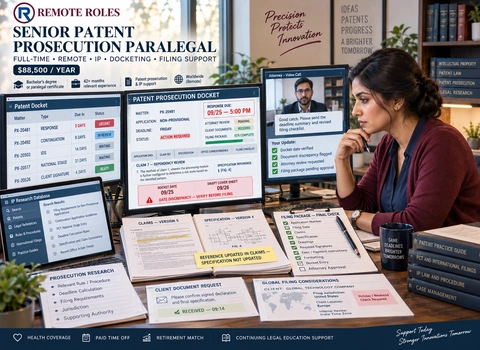
Patent prosecution paralegal work runs on deadlines that do not move: miss a response window with the patent office and an application can go abandoned, no exceptions. That reality shapes everything about this senior, full-time, fully remote role.
This is a support role sitting close to the attorneys handling the actual legal strategy, but with real ownership over the mechanics that keep a filing on track. A firm's reputation for reliability with clients often rests more on whether deadlines get hit cleanly than on any single legal argument, which puts this role closer to the center of client trust than its title might suggest.
The work
- Draft and review legal documents connected to patent prosecution matters, including correspondence and filing support
- Conduct legal research to support attorneys or in-house counsel on active matters
- Organize case files so nothing gets lost across a docket that can run dozens of matters deep
- Track filing and response deadlines with zero margin for error
- Coordinate directly with clients and outside parties, including outside counsel and patent offices
- Help ensure filings and correspondence stay compliant with relevant rules and formatting requirements
None of this is theoretical. A single missed docket entry on a continuation application can cost a client years of protection on an invention, so the organizational side of the job carries as much weight as the drafting side. A strong paralegal in this role is the person an attorney trusts to flag a problem three weeks before it becomes urgent, not the day it does.
Picture a client with a provisional patent filed twelve months ago and a non-provisional deadline landing on a Sunday in a country that observes a different holiday calendar than the firm's own. Figuring out the real filing date, confirming it with the right office, and getting the attorney a clean summary before Friday is a normal Tuesday in this role, not an unusual crisis.
What you need to bring
Candidates typically hold a bachelor's degree or a paralegal certificate, plus prior experience in a law firm or legal support role. Strong legal research skills are non-negotiable, and so is comfort with document review at volume. This is a senior position, so 42 months of relevant paralegal experience is required, most of it ideally spent supporting patent or intellectual property work specifically rather than general litigation.
Attention to detail is not a soft skill here. It is the actual job. A paralegal who catches a formatting error in a filing before it goes out saves the firm from a rejection letter and saves the client weeks of delay. That kind of catch happens dozens of times a year in a busy patent practice, and it rarely gets recognized loudly, but it is exactly what separates a senior paralegal from a junior one.
Skills and tools
- Legal research, including patent and IP-specific databases
- Document drafting for filings, correspondence, and internal memos
- Case management software, used daily to track deadlines and matter status
- Sharp attention to detail across long, repetitive document sets
Beyond the core list, experience with docketing software specific to patent prosecution is a meaningful advantage, and so is any exposure to international filing procedures under systems like the Patent Cooperation Treaty. Neither is strictly required, but both shorten the ramp-up period considerably for a firm handling filings across multiple jurisdictions.
Comfort with numbered claims and technical specification language also helps, even without a science background. A paralegal does not need to understand the underlying invention the way an engineer would, but reading a claim set closely enough to catch an inconsistency between it and the specification is a skill that develops with repetition.
Pay and benefits
This full-time role pays $88,500 a year. Full-time patent prosecution paralegal roles at Remoteroles-listed employers commonly round out the salary with a standard package, since staying current on filing rules is part of staying good at this job.
- Health coverage
- Paid time off
- Retirement plan matching
- Continuing legal education reimbursement, where applicable
Ask about the CLE reimbursement specifically during your interview; it is not universal across firms, and it is worth confirming rather than assuming.
Remote, worldwide, and still deadline-driven
This is a fully remote position open to candidates anywhere, with no office and no city requirement attached to it. That does not mean loose hours. Patent deadlines run on fixed dates set by patent offices, so you will need enough overlap with the attorneys and clients you support to hit filing windows and respond to urgent requests same-day when needed. Most coordination happens through case management software, email, and scheduled calls rather than an office hallway conversation, which actually suits paralegals who prefer to concentrate on documents without constant interruption. A well-run remote docket depends on clear written status updates rather than someone stopping by a desk to ask how something is going.
Confidential invention disclosures and unfiled applications also mean the role leans on secure document-sharing practices more than a typical remote job might. Firms generally provide access to their own case management and file-sharing systems rather than expecting a paralegal to improvise with personal tools, which keeps sensitive client work where it belongs.
Why this role is worth a serious look
Patent work does not slow down. Demand for experienced prosecution support keeps growing as more companies file globally, and a senior paralegal who can run a docket cleanly is genuinely hard to replace. This is a role where competence gets noticed fast, for better or worse, and it tends to open doors toward patent agent training or higher-level IP support roles for paralegals who want to keep climbing in this specific direction.
Salary progression in patent support tends to track experience closely, and a paralegal who has spent three or four years specifically in prosecution, rather than general corporate or litigation support, usually commands a noticeably higher rate than one with broader but shallower legal experience.
How to apply
Submit your resume along with specific examples of patent prosecution matters you have supported, not just general litigation experience. Strong candidates typically move to a short skills assessment covering docketing accuracy and document review before a final interview with the hiring team.