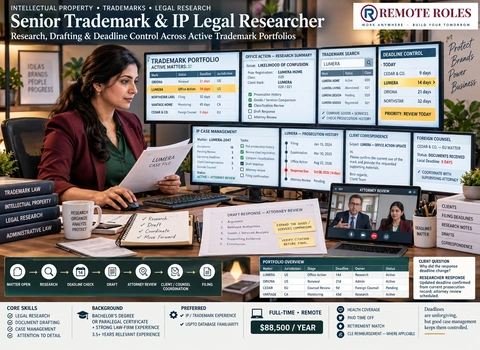
Trademark deadlines do not bend for anyone. Miss a filing window and a client's mark can lose its priority date entirely, which is exactly why this research seat exists.
Trademark portfolios are corporate assets, and a lapsed filing or a missed response can mean losing rights that took years and real money to build. Legal teams handling multiple marks across multiple jurisdictions cannot track every date from memory, which is where a dedicated researcher earns their keep.
What lands on your desk
Attorneys and in-house counsel hand off the research and drafting work that keeps their caseload moving, and this role is where that work actually gets done. Expect a steady flow of documents to review, cases to organize, and deadlines to track against a calendar that does not forgive slippage. The volume is real, and it does not let up in slow months the way some legal support roles do.
- Draft and review legal documents in support of attorneys or in-house counsel
- Conduct trademark and IP research across public and proprietary databases
- Organize and maintain case files so nothing gets lost between handoffs
- Track filing and response deadlines across an active caseload
- Coordinate with clients and outside parties to keep filings and correspondence compliant
How caseloads get organized
A caseload like this rarely stays static. New matters open while older ones move toward a decision, and case management software exists specifically so nothing falls through that transition. Part of the job is triaging which matter needs attention today versus which one has three weeks of runway left, and flagging to the supervising attorney the moment a deadline looks tight rather than assuming it will resolve itself.
Not every matter is a straightforward renewal. Some involve responding to office actions, others involve monitoring for potential infringement, and a few require coordinating with foreign counsel when a mark needs protection outside the usual filing jurisdictions. That variety keeps the role from feeling like the same task on repeat.
Client and outside-party coordination
Clients are not always lawyers themselves, and explaining why a routine renewal suddenly needs an affidavit of use, or why a deadline moved because a foreign associate flagged something, is part of the researcher's job as much as the paperwork itself. Some clients want a two-line email. Others want a full explanation of the reasoning behind a filing decision, and reading which kind of client is on the other end of a thread is a skill that develops with time rather than something taught directly on day one.
Outside parties, like foreign counsel or process servers, add another layer, since their deadlines and communication norms do not always match the ones a domestic firm runs on. Keeping all of that straight without letting one relationship's expectations bleed into another is a real, if underappreciated, part of what separates someone good at this job after a few years from someone merely competent at it in the first few months. A researcher who can hold three or four of these threads at once, without letting one deadline quietly slip while attention is on another, is exactly who this posting is written for.
Skills and background this role needs
A bachelor's degree is the standard requirement, though a paralegal certificate is accepted in place of one for candidates with strong law firm experience behind it. Three and a half years of relevant legal support experience is expected, ideally including time spent specifically in IP or trademark work rather than general litigation support. Familiarity with the USPTO trademark database is a genuine plus, though not everyone comes in with it already.
- Legal research
- Document drafting
- Case management software
- Attention to detail
What the research grind actually looks like
Say a client's mark gets an office action citing a confusingly similar prior registration. This researcher pulls the prosecution history, checks the goods and services classes for real overlap, and drafts the first pass at a response before an attorney ever touches it. Getting that first draft right saves the attorney hours, and it is the kind of work that either builds trust fast or does not.
Where this role can lead
Researchers who spend a few years in this seat often move toward a paralegal specialization in IP, a trademark administrator role, or in some cases toward law school with a real head start on the subject matter. None of that is promised, but the exposure to genuine prosecution work is the kind of experience that stands out on a future application.
Pay and time off
The salary for this role is $88,500 a year, full-time. Health coverage, paid time off, and retirement plan matching are standard, and continuing legal education reimbursement is available where it applies, which matters for anyone maintaining a paralegal certification.
- Health coverage
- Paid time off
- Retirement plan matching
- CLE reimbursement where applicable
Working remote against real deadlines
Legal deadlines do not care what time zone anyone is in, so this role runs on a mix of overlap hours with the supervising attorney and independent focus time for the research itself. Remoteroles posts roles like this one from firms and legal departments that have already built their workflows around case management software and shared document systems, so the tools needed to do the job well are already in place before day one. Case files, deadline calendars, and correspondence typically live in one shared system, so a researcher working from anywhere sees the same information the supervising attorney sees, updated in real time rather than through a weekly export.
Apply for this role
Send an application through this listing with a resume that highlights specific IP or trademark experience, not just general legal support. Writing samples help if you have them ready, especially anything showing a legal argument built from the ground up. The hiring team moves quickly on this one given how deadline-driven the work is, so candidates who apply promptly, rather than waiting until a posting has been up for weeks, tend to hear back faster than those who let it sit.