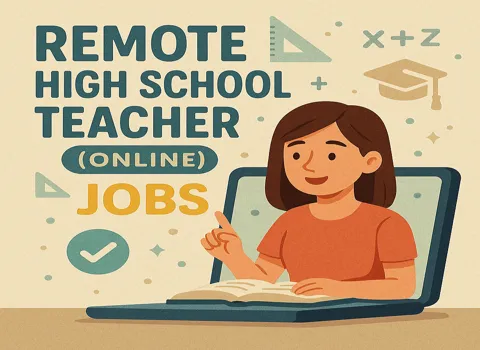
Remote High School Teacher (Online)
Job Snapshot
A classroom doesn’t always have four walls anymore. Sometimes it exists inside a quiet bedroom, a shared living space, or a kitchen table where a student logs in with half-awake eyes and a full day ahead of them. In that moment, a Remote High School Teacher becomes the difference between just attending a class and actually learning something from it.
This role comes with an annual salary of $57,250, but the work itself can’t really be measured in numbers alone. It shows up in small turning points—when a student who rarely speaks suddenly answers correctly, or when someone who usually falls behind starts catching up without being chased.
It’s teaching, yes, but shaped by screens, delays, distractions, and the quiet challenge of holding attention in a world that keeps pulling it away.
Your Impact Area
The impact here isn’t loud. It builds slowly, almost invisibly at first.
A student who used to disappear behind a turned-off camera starts showing up consistently. Another who was struggling to follow lessons began asking for clarification instead of giving up. These changes don’t happen because of pressure—they happen because someone kept showing up and making things understandable.
In a virtual classroom, everything depends on how learning is conducted, not just on what is taught. Platforms like LMS systems, video classes, and digital assignments provide structure, but they don’t create connection. That part comes from how a teacher reads the room—even when the room is a grid of small video boxes.
Over time, students begin to trust the process. They stop treating online learning as temporary and start engaging with it as if it actually matters.
Daily Flow of Work
No two days feel exactly the same, even if the schedule looks identical on paper.
Before classes begin, there’s usually a quiet review of what happened the previous day. Maybe a topic didn’t land well, or a group of students needed more time than expected. Those small details shape how the next session is adjusted.
When teaching begins, things rarely go exactly as planned. A student asks something unexpected. Another responds in chat instead of speaking. Someone looks confused, and the explanation shifts mid-sentence because staying rigid doesn’t work here.
There’s a constant adjustment happening in real time.
After class ends, the pace slows, but the work continues. Assignments come in through online systems, and feedback is written carefully—not just marked, but explained in a way that actually helps the student understand where they went wrong.
Patterns slowly start to show up. Some students need more time. Some just need a different explanation. Others are improving quietly without saying much at all.
What This Role Requires
Knowing the subject is only the starting point. The real skill is making it make sense through a screen.
Online teaching isn’t just a digital version of a classroom—it behaves differently. Attention shifts faster, silence means something different, and engagement has to be earned more deliberately.
Comfort with tools like video conferencing platforms, online classrooms, and LMS systems is part of everyday work. But tools don’t carry the lesson. They just deliver it.
What matters more is awareness—knowing when students are following along and when they’ve drifted away without saying a word.
There’s also a kind of patience required here that isn’t about waiting—it’s about adjusting without frustration when things don’t land the first time, or even the second.
Work Setup
The role is fully remote, but it isn’t casual.
Classes still start at fixed times. Assignments still have deadlines. Students still need responses that are timely and clear. The flexibility is in where the work happens, not in whether it happens.
One day might be a home office. Another might be a quiet corner with stable internet. The location changes, but the responsibility doesn’t.
Even though teaching happens remotely, it’s not isolated work. There’s constant coordination with other educators and academic teams to ensure students aren’t slipping through the cracks unnoticed.
Tools That Shape the Classroom
The classroom lives inside systems rather than rooms.
A learning platform holds everything together—lessons, assignments, progress tracking, and feedback. Video calls become the main space where teaching actually happens in real time.
Sometimes a concept needs to be drawn out visually. Sometimes it needs to be broken into smaller steps. That’s where digital whiteboards and presentation tools come in.
Outside of class, messaging tools keep communication open. Students ask questions. Teachers clarify doubts. Learning doesn’t stop when the session ends—it just changes form.
Each tool plays a part, but none of them replace the human side of teaching.
A Real Teaching Moment
A biology lesson on ecosystems is scheduled for the day. Before it begins, there’s a quick look at recent performance data. A pattern stands out—several students still don’t fully understand food chains.
So the lesson starts differently than planned.
Instead of moving straight into new material, the teacher brings it back to something familiar. Students are asked to think about places they’ve actually seen nature—parks, gardens, even small trees near their homes.
The conversation starts slow, then picks up. One student makes a connection that shifts the class in a new direction. Another adds something unexpected. The topic stops feeling like textbook content and starts feeling real.
Not everyone gets it immediately, so the explanation changes again. Simpler language. Fewer terms. Slower pacing.
After class, a short assignment goes out through the system. The results later help decide what needs revisiting. Nothing dramatic changes—but learning continues, step by step.
Who Fits This Work
This role suits someone who’s comfortable teaching without a physical classroom while still keeping students engaged.
It suits educators who don’t rely on one fixed method. Some lessons need structure, others need flexibility, and most need both at different points.
Experience with online teaching helps, but adaptability matters just as much—sometimes more.
The strongest fit is someone who pays attention to how students are learning, not just whether they are logged in.
Next Step Forward
Remote education is still evolving, and roles like this are shaping what it becomes.
It’s not about replacing traditional classrooms—it’s about making learning work in environments where students are already living their daily lives.
If this way of teaching feels natural, the next step is simple: apply and step into a role where education is still structured, still purposeful, but far more flexible in how it reaches students.