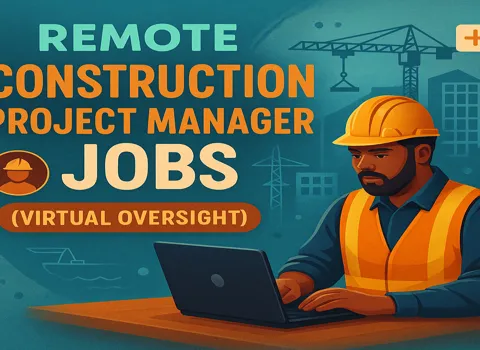
Remote Construction Project Manager – Virtual Oversight
Construction work has a funny way of looking organized from a distance. Clean timelines. Clear milestones. Everything is neatly stacked in charts and folders. Then you get closer to it and realize it’s more like a living thing—always reacting, always adjusting, never exactly staying where you planned it to be.
That’s the space this role lives in.
Not on-site swinging between meetings and machinery, but not detached either. More like sitting in the middle of the noise and trying to make sense of it before it turns into confusion.
And most days, the job is less about “managing” in a loud way and more about noticing small shifts before anyone else thinks to look twice.
Position Insights
There’s no dramatic start where everything begins at once. It just sort of unfolds.
You open your dashboard, check a few updates, and immediately start reading between the lines.
A project that looked fine yesterday might have a small timing shift today. Nothing alarming on its own, but you pause for a second anyway. Because experience teaches you something simple: small changes rarely stay small.
Some mornings feel almost quiet. Everything is moving as expected, and your job is just to keep it that way.
Other times, you can tell right away something’s been nudged out of place. Not broken—just slightly off rhythm. That’s usually where your attention goes first.
Why This Position Exists
Most construction delays don’t announce themselves. They don’t arrive with warning signs or big red flags.
They show up quietly.
A delivery slips by a day. A subcontractor works off a slightly different assumption. A schedule update doesn’t reach everyone at the same time.
On their own, none of it feels urgent. But together, they start to create pressure points in the timeline.
This role exists to catch those pressure points early.
Not in a dramatic “rescue the project” way—more in a steady, behind-the-scenes way where problems get handled before they grow legs.
Sometimes it’s a quick correction. Sometimes it’s just asking the right question that brings clarity back into the room.
Your Daily Tasks
Honestly, no two days feel identical, even if there’s a familiar pattern underneath.
You might start by looking at project movement—not just whether tasks are complete, but how things are flowing. Is everything moving smoothly? Or is something quietly slowing down without explanation?
Then the messages start coming in.
A site supervisor checks in about timing. A contractor asks for confirmation on sequencing. Someone flags a small change that could affect the next phase.
It’s not formal most of the time. It’s quick, practical communication that keeps everyone aligned without overcomplicating things.
Budgets sit in the background, but they never fully disappear from your thinking. A small shift in cost doesn’t usually feel urgent in isolation—but you’ve seen how those small shifts behave over time if nobody pays attention.
Documentation happens in bits and pieces throughout the day. An update here, a revised note there, a confirmation saved before moving on. Nothing dramatic, but it keeps everything traceable when you need to look back.
And then there are those unexpected moments—something slips, something changes, and you have to respond without overthinking it.
Required Skills
If you’ve worked in construction before, a lot of this will already feel familiar in a practical way.
Project coordination, site communication, or civil engineering experience all help—but not just because of technical knowledge.
It’s because you already understand how quickly things can shift once real work begins.
But the real difference in this role comes down to how you handle incomplete information.
Because you won’t always have the full picture.
Sometimes you’ll get half an update. Sometimes, two updates don’t fully match. Sometimes everything looks fine until you connect the dots and realize something doesn’t line up.
So you get used to thinking in layers instead of snapshots.
Communication matters too, but not in a polished corporate sense. More in a “make sure nobody is confused” sense. Clear, direct, no unnecessary noise.
You’ll also rely heavily on tools—project tracking systems, scheduling platforms, and reporting dashboards. They become your eyes on the work.
Not complicated, just essential.
And then there’s judgment. That part is harder to teach.
Knowing when to step in immediately… and when to let something run a little longer before reacting.
Work Environment
Even though this is fully remote, it doesn’t feel distant or quiet.
There’s always something moving in the background.
Messages are coming in at different times. Updates from the site. Small adjustments to schedules. Quick clarifications that need answers before the day moves too far ahead.
Some parts of the day are calm—just reviewing, organizing, making sense of everything.
Other parts are reactive, where something shifts, and you adjust on the fly.
There’s flexibility in how you structure your time, but the responsibility doesn’t really move. Projects don’t pause just because the timing gets inconvenient.
So you stay connected to them in your own rhythm.
Tools Used
Most of what you work with isn’t physical—it’s digital.
Project management platforms show how everything connects. Scheduling tools highlight where delays might ripple. Communication apps keep conversations moving without waiting for formal meetings.
Cloud storage keeps all the documents in one place—plans, drawings, approvals, reports.
Budget tools quietly show where things are stable and where small shifts are starting to appear.
Individually, none of it feels complicated. But together, it gives you the full picture.
Or at least as close to it as possible without being on-site.
Practical Example
A shipment of material is delayed by a few days.
At first, it doesn’t seem like much. These things happen.
But when you trace it through the schedule, you see it affects a chain of tasks that depend on it.
If you wait too long, those tasks sit idle.
So instead of letting it play out, you adjust early.
Non-dependent work moves forward. Contractors shift timing slightly. The sequence is reshaped so the delay doesn’t spread.
Nothing dramatic happens. No escalation. No disruption that anyone really feels on-site.
Just a small correction that keeps everything flowing.
That’s a big part of this role—fixing things before they grow into visible problems.
Who This Suits
This role tends to work best for people who don’t need everything perfectly laid out before they act.
People who are comfortable working with partial information and still making sense of it.
You notice when something feels slightly off—even if nobody has officially flagged it yet.
Not in an alarmist way. Just a quiet awareness that something doesn’t quite match the pattern.
If you’ve worked in construction environments, the logic will feel natural.
If not, what matters more is how quickly you adjust when real-world conditions don’t match the plan.
Apply Now
This role sits between planning and execution and does not require physical on-site presence.
Structured, but flexible. Independent, but still deeply connected to real work happening in the field.
The annual salary is $95,468, reflecting the level of coordination and responsibility required to keep multiple construction projects aligned remotely.
If you tend to notice problems early, prefer fixing things before they grow, and stay calm when priorities shift, this kind of work will probably feel more natural than expected.