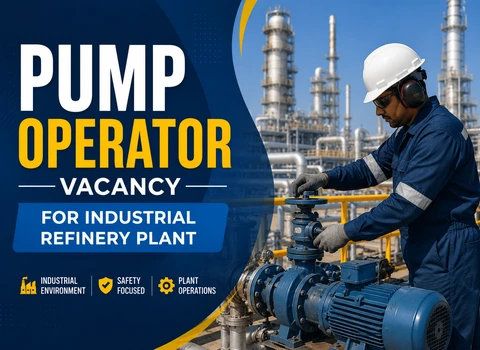
What a Pump Operator Actually Does in a Refinery
Crude oil, fuel, water, and various chemicals move through a refinery in a constant stream, day and night. Someone has to watch that movement closely, and that someone is the pump operator. The job sounds simple on paper: start pumps, stop pumps, keep an eye on pressure. In practice, it takes a trained eye to catch the small signs that something is about to go wrong before it actually does. A Pump Operator Vacancy for Industrial Refinery Plant is built around exactly that responsibility.
Why This Role Exists in the First Place
Automated sensors handle a lot of the monitoring in modern refineries, but they don't catch everything. A pump that sounds slightly off, a gauge that's creeping upward faster than usual, a faint smell near a seal — these are things a person notices on a walkthrough that a control panel might miss for a few extra minutes. Since refinery processes run continuously, those few minutes matter. That's the practical reason plants keep hiring people for this position instead of leaving it entirely to automation.
How a Shift Usually Unfolds
Most shifts start with a handover. The outgoing operator explains what happened, what's running normally, and what to watch. From there, the work settles into a rhythm:
- Walking the unit to check pumps, valves, and connected piping
- Reading pressure gauges, flow meters, and temperature indicators at set intervals
- Starting or shutting down pumps as production schedules require
- Logging readings, either on paper or through a plant's digital system
- Flagging anything unusual to maintenance before it becomes a bigger problem
It's repetitive work in some ways, but the repetition is the point. Catching a problem early usually comes down to noticing that today's reading is different from yesterday's.
The Equipment Operators Work With
Centrifugal and positive displacement pumps handle most fluid transfer in a refinery, and operators need to understand how each type behaves differently under load. Alongside the pumps themselves, the job involves constantly reading pressure gauges, flow meters, and temperature sensors, and increasingly checking the same data on a control room screen. Plants that have modernized their systems still expect operators to trust their own eyes and ears as much as the digital readout.
Skills That Actually Matter Here
Technical knowledge helps, but it's not the whole story. A candidate who understands fluid mechanics but panics during an unusual pressure spike isn't much use on the floor. What tends to separate a good operator from an average one:
- Genuine familiarity with how pumps and pressure systems behave
- Comfort reading gauges and process charts without hesitation
- Enough physical stamina to stay on your feet and moving through a full shift
- A habit of writing down accurate readings, even when nothing seems wrong
- Staying level-headed when something does go wrong
An ITI certificate in a trade like Fitter, Mechanical, or Electrical gives candidates a reasonable head start. Diploma holders in Mechanical or Chemical Engineering are also considered strong applicants. That said, plants often value someone who has actually stood next to a working pump before over someone who has only studied the theory.
Location and Nature of the Work
The position is based at an industrial refinery plant in Bina, Madhya Pradesh, and it's listed as Full-time. Refinery operators generally don't stay in one place through a shift — expect time outdoors near pump stations, time inside enclosed process units, and time in the control room reviewing data with the rest of the team.
What the Environment Feels Like
Heat and noise are part of daily life on a refinery floor, and there are stretches where the smell of petroleum products is hard to ignore. Night shifts come with the territory since pump operations don't pause when the sun goes down. Physically, the role requires a fair amount of standing and walking, plus occasional lifting when assisting maintenance with small tasks.
Staying Safe Around High-Pressure Systems
Refineries treat safety procedures as non-negotiable, not as suggestions. Lockout-tagout steps must be followed before any maintenance work begins, and operators are trained to report any unusual conditions rather than attempt a fix themselves.
Standard protective gear on the job typically includes:
- Fire-resistant coveralls
- A safety helmet and goggles
- Steel-toe boots
- Hearing protection in loud sections of the plant
- Gas detection equipment in areas where vapors could build up
Where New Operators Struggle Early On
The sheer number of readings can feel overwhelming to keep track of in the first few weeks. Telling a normal fluctuation apart from an early warning sign comes with time on the equipment, not from a manual. Working long shifts in the heat takes some getting used to, especially for candidates coming from indoor jobs.
Operators who do well tend to learn the specific pumps at their plant inside and out, rather than relying solely on general training knowledge. Double-checking readings before signing off on a shift is a small habit, but it saves the next person from inheriting a mistake.
Where This Can Lead
Operators who stay consistent and keep building their technical understanding are often considered for senior operator roles or shift-in-charge positions down the line. Gaining familiarity with related equipment, such as compressors or heat exchangers, tends to make an operator more valuable to the plant over time, without requiring a change in career direction.
Pay and What Might Come With It
The role pays ₹ 38,200 per month. Beyond the base salary, some employers offer extras like overtime pay, PF, ESI, uniforms, transport, or canteen access — though these vary by employer and shouldn't be assumed without confirmation.
For someone in Bina, Madhya Pradesh looking to get into refinery work, this Pump Operator Vacancy for Industrial Refinery Plant is a reasonable place to start, with a clear enough path forward for anyone willing to put in the time on the floor.