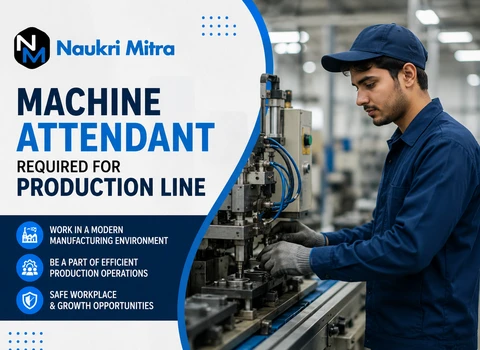
What Actually Happens on a Production Line
A production line looks simple from the outside — parts go in one end, finished pieces come out the other. But someone has to sit at each machine, feed it correctly, and catch problems before they turn into wasted material or a stopped line. That's the job behind the title "Machine Attendant Required for Production Line," and it's a role you'll find in factories across Rajkot, Gujarat, wherever things are manufactured at scale.
The position is Full-time, based in Rajkot, and it tends to suit people who don't mind repetition, can stay alert through long stretches, and get some satisfaction from a well-run shift.
Why This Job Exists in the First Place
Machines don't run themselves, not really. Someone has to load them, watch for anything off — a strange sound, a part that comes out slightly wrong, a temperature that's crept up — and act on it fast. Get this wrong and a factory loses hours of output or scraps a whole batch of material. Get it right, and the operator becomes one of the more valuable people on the floor, even if the job title doesn't sound glamorous.
How a Shift Usually Goes
There's a rhythm to it, though the details shift depending on what's being made. An operator generally starts by checking the machine over, reading notes left by the previous shift, and confirming there's enough raw material on hand. From there, the actual work involves things like:
- Loading components or raw material into the machine
- Running the equipment through its cycle and watching output
- Checking finished parts against basic quality specs
- Logging production numbers and any downtime
- Cleaning and oiling machine parts as needed
- Flagging anything unusual — noise, vibration, heat — to maintenance before it becomes a bigger problem
Some shifts move fast with barely a break in the routine. Others involve long stretches of monitoring where the real skill is staying attentive even when nothing seems to be going wrong.
Where This Kind of Work Happens
Engineering workshops, casting and forging units, plastic and rubber processing plants, and auto component manufacturers all hire for roles like this. A smaller workshop might have one or two machines and a tight-knit team; a larger plant could run several parallel lines with dozens of operators working in shifts. Rajkot's industrial base, known for engineering and casting units, gives this kind of role plenty of ground to exist on.
The Equipment You'll Actually Work With
Depending on the line, this could include press machines, molding equipment, CNC or conventional lathes, or general material-handling gear. Measuring is part of the job too — vernier calipers, micrometers, and gauges get used regularly to check whether a part is within spec. Employers sometimes look for candidates with machining or toolroom training. An ITI in a machining trade, a diploma in Mechanical or Tool and Die Engineering, or similar vocational training can help here, and hands-on exposure to EDM machines, reading engineering drawings, and using precision instruments often counts for as much as the certificate itself.
Skills That Actually Matter Day to Day
Being able to read a basic engineering drawing helps. So does a working sense of mechanical troubleshooting — knowing when a sound means "adjust something" versus "call maintenance now." Attention to detail catches defects before they pile up. And none of this works without discipline: following the standard procedure even on a slow day, not cutting corners because nobody's watching. Shift handovers also depend on clear communication — a rushed or vague handover tends to cause problems on the next shift.
The Physical Side of the Job
Expect to be on your feet for most of the shift. Some lifting is involved, and if the plant runs round the clock, shift work comes with the territory. It's not a desk job — comfort with standing, repetition, and staying focused for hours at a stretch matters more here than in many other roles.
Safety Isn't Optional
PPE — safety shoes, gloves, eye protection — is standard in this kind of environment, and lockout procedures before servicing a machine exist for a reason. Heat near certain equipment, noise levels, and the general risk of a moving machine mean attention can't drift for long. Most accidents on a shop floor happen in the ordinary moments, not the dramatic ones, which is exactly why routine vigilance matters more than occasional caution.
Where Experience Can Take You
Operators who stick with it and build a track record often move into senior operator roles, shift-in-charge positions, or more specialized machine-handling work within the same plant or industry. It's not unusual for someone who started on the floor to end up supervising a section a few years in.
Pay and What Else Might Come With It
The role pays ₹24,000 a month. Beyond the base salary, some employers offer extras like overtime pay, PF, ESI, bonuses, uniforms, transport, or canteen access — though these vary by company and shouldn't be assumed to be guaranteed.