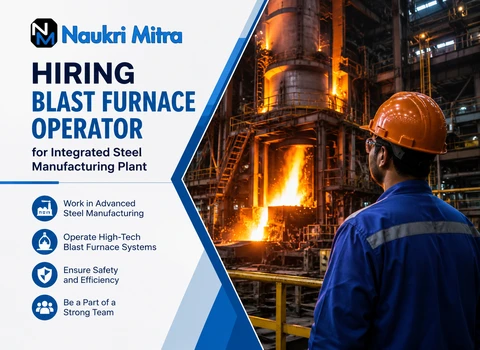
What Actually Happens Inside a Blast Furnace
Iron ore, coke, and limestone go in. Molten iron comes out. In between, temperatures inside the furnace shaft climb past 1,500 degrees Celsius, and someone has to make sure that entire chain of reactions stays under control the whole time. That someone is the Blast Furnace Operator, sometimes called a furnace operator, production technician, or plant operator depending on which plant you ask.
It's not a glamorous job title, but it's a load-bearing one. Nearly every finished steel product in existence — rods, sheets, beams, wire — traces back to a furnace stage like this one.
This opening is a Full-time position in Bhilai, Chhattisgarh, a city long associated with large-scale iron and steel production. Anyone who's grown up around Bhilai has probably seen the plant's stacks from a distance without quite knowing what goes on inside them. This is what goes on inside them.
Why This Job Exists at All
Automation handles much of the furnace's routine operation, but not all of it. A furnace left unwatched is a liability. Pressure creeps up, a feed system jams, a tuyere starts behaving oddly — and a control panel alarm often catches these things later than a trained eye watching the gauges would.
That's really the whole case for hiring operators instead of just running things on autopilot: judgment. Reading a slightly-off pressure trend and acting on it before it becomes a real problem is something software still struggles to replicate reliably. Sponge iron units and other integrated metal plants across the country lean on this same logic.
How a Shift Usually Plays Out
Ask five operators what their day looks like, and you'll get five slightly different answers, but the backbone is similar. There's the constant checking of temperature, gas pressure, and blast air readings. There's watching how raw material gets charged into the furnace — too fast or too slow, and the whole burden shifts downstream. Tapping time, when molten iron and slag are released, is often the most tense part of any shift, since timing and coordination with the rest of the crew matter more here than anywhere else.
Beyond that, there's a fair bit of record-keeping. Every unusual reading gets logged and passed along, because the next shift needs to know what happened before they walk in. When the furnace goes down for relining or repair — which is planned well in advance, never spur of the moment — operators end up working alongside maintenance teams for days at a stretch.
The Equipment You'll Be Standing In Front Of
Control panels, hot blast stoves, gas cleaning systems, tuyere monitors, and a whole row of temperature and pressure gauges make up most of an operator's daily environment. Newer plants have shifted much of this onto SCADA screens, though the older manual gauges rarely disappear entirely — they're the backup when a screen freezes, or a sensor drifts.
What Separates a Good Operator From a Struggling One
Knowing the metallurgy helps, but it's not the whole picture. A lot of the job comes down to staying level-headed when a reading suddenly doesn't match what it should. Some operators are naturally good at this; others build it up over months on the floor.
A few things tend to matter more than people expect going in — comfort with reading gauges and dashboard displays without second-guessing every number, the physical stamina to be on your feet near a heat source for hours, and an instinct for when to flag something to a supervisor rather than wait and see. None of this is a solo effort either. Furnace crews function as a unit, and an operator who can't communicate clearly under pressure struggles no matter how sharp their technical knowledge is.
On the qualifications side, plants typically look at ITI holders from Electrician or Fitter trades, or diploma graduates in Metallurgy or Mechanical Engineering. That said, someone who's already spent time around furnace or foundry equipment usually settles in faster than a fresher would, even if the fresher's paperwork looks stronger on paper.
Life on the Floor: Heat, Noise, and Shift Timing
There's no getting around the heat. Dust from raw material handling and the constant noise of machinery are part of the package too. Because a blast furnace can't just be switched off for the evening, shift work is the norm — day shifts, night shifts, and the rotation between them.
Night shifts in particular test a person's alertness in ways day shifts don't. Standing for long stretches, climbing platforms around the furnace body, and reacting fast during a tapping sequence all demand a level of physical readiness that's worth being honest with yourself about before taking on this kind of work.
Staying Safe Around Molten Metal
This isn't an area where shortcuts are an option. Heat-resistant clothing, helmets, face shields, gloves, and furnace-rated safety shoes are standard gear, and most plants run new operators through induction training before letting them anywhere near an active furnace zone. Safety drills happen regularly, not as a formality but because the margin for error near molten iron is genuinely thin.
The tricky part isn't usually the big, obvious dangers — it's the smaller, repetitive risks. A rushed reading during an unplanned stoppage. Fatigue creeping in during the sixth hour of a night shift. Operators who last in this line of work tend to develop a habit of double-checking, even when the pace picks up.
Where This Job Can Take You
Most people don't walk straight into independent furnace monitoring on day one. It usually starts with support duties — learning the layout, understanding the instrumentation, shadowing someone more experienced — before moving into solo responsibility. From there, paths open toward senior operator roles, shift-in-charge positions, or furnace maintenance specializations, usually within the same plant. A clean safety record and steady performance count for more here than almost anything else when it comes to moving up.
Pay and What Else Might Come With It
The monthly salary for this role is ₹42,500. Beyond the base pay, some employers in this line of work offer additional benefits such as PF, ESI coverage, overtime, bonuses, uniforms, or transport and canteen facilities — though these vary from one company to another and are best confirmed directly rather than assumed.
If you're weighing this against other options in India's steel sector, this is about as close to the core of the process as production work gets. It's hands-on, it's demanding in places, and the learning curve is real — but for someone willing to put in the time, it's also a fairly stable long-term bet.