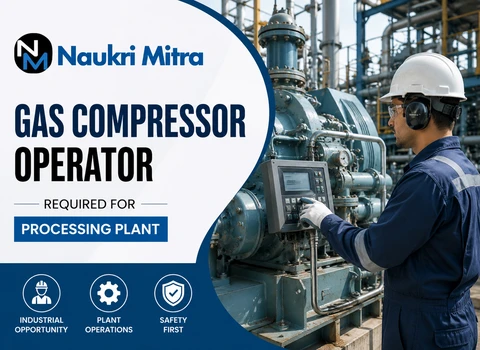
What Does a Gas Compressor Operator Actually Do?
Walk into any gas processing plant, and you'll find compressors running almost around the clock. Someone has to watch them. That's the job of a Gas Compressor Operator — a full-time position currently open in Dahej, Gujarat, India, at a processing plant that depends on these machines staying pressurized, cool, and leak-free every hour of every shift.
It's not a desk job. You're on your feet, checking gauges, listening for odd sounds, and making judgment calls when a reading looks slightly off before it becomes a real problem.
Why This Role Exists in the First Place
Gas doesn't move on its own through a processing system — it needs pressure, and compressors create that pressure. If nobody's watching them, small issues (a slow leak, a rising temperature, a vibration that wasn't there yesterday) can turn into shutdowns or worse. That's really the whole reason plants hire dedicated operators instead of leaving compressors on autopilot. One pair of trained eyes on the equipment saves far more money than it costs.
A Shift, Start to Finish
Most days start with a walk-around. You check oil levels, pressure readings, temperature gauges, and note anything unusual before the shift officially begins. Then it's a mix of monitoring and reacting — logging numbers every so often, adjusting settings when needed, and staying alert for alarms.
Some hours are quiet. Others aren't. When a pressure alarm goes off, there's no time to second-guess; you follow procedure, isolate the issue if you can, and call it in if you can't. By the end of the shift, there's a handover — verbal and written — so the next operator knows exactly where things stand.
What the job typically involves:
- Starting up and shutting down compressor units following set procedures
- Tracking pressure, temperature, and flow readings throughout the shift
- Spotting early warning signs before they become failures
- Basic maintenance — lubrication, filter checks, small adjustments
- Following lockout-tagout steps whenever equipment is being serviced
- Keeping shift logs accurate, since the next operator relies on them
The Kind of Place You'd Work
Dahej has grown into one of Gujarat's more established industrial belts, and gas processing operations are part of that landscape. As a compressor operator here, you'd likely split time between a control room and the actual compressor yard outside — checking a screen one moment, standing next to the machine the next. It's not purely indoor work, and it's not purely outdoor either.
Equipment You'll Get to Know Well
The compressors themselves — reciprocating or centrifugal, depending on the plant setup — are the main equipment, but they're not the only things you'll touch. Pressure gauges, flow meters, and temperature sensors become second nature after a few weeks. Larger plants also run SCADA systems or digital control panels, so some comfort with screens and digital readouts helps, even if you're coming from a purely mechanical background.
Who Tends to Do Well in This Role
There's no single path in. Some operators come through an ITI course in a relevant mechanical or instrumentation trade. Others have a diploma in mechanical engineering. And a fair number learn most of what they know on the floor, working under senior technicians. What employers actually care about is whether you can read a gauge correctly, understand what a pressure trend means, and stay calm when something isn't behaving as it should.
Experience with engineering drawings or precision measuring instruments is a plus, though not always required — it depends on how the plant is set up and the level of responsibility the role entails.
Skills Beyond the Technical Manual
Knowing how a compressor works on paper is one thing. Doing the job well is another. Operators who last in this field tend to have a few things in common — they notice small changes before anyone points them out, they don't panic when three alarms go off at once, and they communicate clearly with whoever's in the control room or on the maintenance team. None of that gets taught in a classroom, exactly. It comes with time on the job.
The Physical Side of the Work
Expect to be on your feet for most of the shift, walking between units, occasionally climbing to check something at height. Plants run continuously, so this is shift-based work — you may find yourself on a rotating schedule that includes nights. It suits people who don't mind an irregular routine and can stay sharp even during a 2 a.m. shift.
Staying Safe Around Pressurized Gas
This isn't an area where shortcuts are acceptable. Gas under pressure is unforgiving if something goes wrong, so safety procedures aren't optional extras — they're the job. PPE typically includes a safety helmet, safety shoes, hearing protection, and flame-resistant clothing, depending on the specific plant's requirements. Operators are also expected to know gas leak detection basics and emergency shutdown steps well enough to act on instinct, not just memory.
What Trips Up New Operators
The hardest part for most beginners isn't the physical work — it's the mental load of reading several gauges at once and figuring out which one actually matters when something goes wrong. Add in plant noise, heat, and the pressure of staying alert for hours, and it takes a while to feel comfortable. Most operators say the first few months are the toughest; after that, pattern recognition kicks in, and it gets easier to trust your own read on a situation.
Growing Within the Same Field
Operators who take the time to understand preventive maintenance or ask to be trained on a second type of compressor usually move up faster. Over the years, that kind of initiative can lead to senior technician roles or shift-lead responsibilities within the same plant or industry — without needing to change fields entirely.
What the Pay Looks Like
This particular position, based in Dahej, Gujarat, pays ₹41,800 per month. It's a full-time role, suitable for both freshers with the right technical background and experienced operators looking for a stable, ongoing position in gas processing.
Other Things That Might Come With the Job
Depending on the employer, roles like this sometimes include extras such as overtime pay, PF, ESI, an annual bonus, uniforms, or transport and canteen facilities. These aren't guaranteed at every plant — they vary — but they're common enough in this line of work to mention.