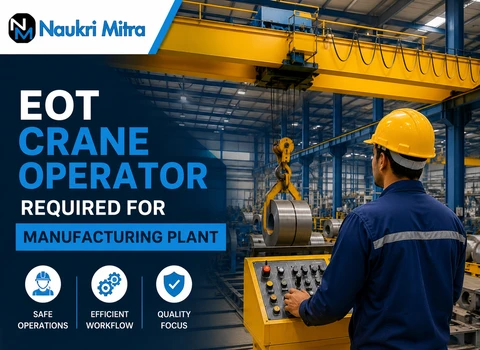
Life Behind the Controls of an Overhead Crane
Walk into any large manufacturing plant and look up. Somewhere near the roof, moving heavy steel coils, machine parts, or finished goods from one end of the shop floor to the other, you will usually find an EOT crane. The person seated in that cabin, or operating it from a pendant control on the ground, is an EOT Crane Operator. This role is currently open at a manufacturing plant in Jamshedpur, Jharkhand, India, as a full-time position offering a monthly salary of ₹33,000.
What an EOT Crane Really Does
EOT stands for Electric Overhead Traveling crane. It runs on rails fixed high along the workshop walls and moves in three directions — along the length of the shed, across its width, and up or down. Factories use these cranes because manually lifting heavy metal sheets, machine components, or raw material is neither safe nor practical. A well-operated crane saves time, protects workers from injury, and keeps production moving smoothly.
Where This Kind of Work Happens
Jamshedpur has long been associated with steel, engineering, and heavy manufacturing, which makes it a natural location for crane-related roles. Operators in this field typically work inside:
- Steel and metal fabrication units
- Heavy engineering and machinery manufacturing plants
- Automobile component factories
- Large warehouses handling bulky goods
Each of these settings depends on smooth material movement, and that is exactly where a skilled operator adds value.
A Typical Day on the Shop Floor
The daily routine of a plant operator handling an EOT crane usually begins with a safety check of the crane's hooks, ropes, brakes, and control switches. Once cleared, the operator receives instructions from the production or dispatch team about what needs to be lifted and where it should go. Throughout the shift, the work involves careful judgment — estimating load weight, maintaining balance, and coordinating with riggers or helpers on the ground via hand signals or radio.
Core Responsibilities on the Job
- Operating the crane to lift, move, and place materials accurately
- Inspecting slings, chains, and hooks before every lift
- Reporting unusual sounds, vibrations, or wear in crane parts
- Maintaining a logbook of lifts and any maintenance issues
- Following load charts to avoid overloading the crane
Tools and Instruments an Operator Works With
In addition to the crane's control pendant or cabin joystick, an operator regularly uses lifting slings, D-shackles, chain blocks, and load-measuring indicators. Familiarity with load charts and basic rigging equipment is considered a practical skill that separates an experienced technician from a beginner.
Skills That Matter Most
Technical understanding of crane mechanisms, electrical controls, and load handling is important, but equally valuable is the practical sense developed through hands-on experience. Employers in Jamshedpur's manufacturing sector often prefer candidates who have completed an ITI in a relevant trade such as Electrician, Fitter, or Mechanist, or a Diploma in Mechanical Engineering. Vocational training combined with real shop-floor exposure is frequently valued as much as formal qualifications, since much of the skill in this profession comes from practice, not just theory.
Physical Demands and Working Conditions
This is an active, alert-driven job rather than a physically strenuous one, but it does require good eyesight, depth perception, and the ability to stay focused for long periods. Since manufacturing plants often run multiple shifts, operators should be prepared for shift-based working hours as part of this full-time role.
Staying Safe in the Cabin and on the Floor
Safety is central to crane operations. Standard practice includes wearing a helmet, safety shoes, and hand gloves, along with strict adherence to load limits and pre-shift inspections. Common challenges include working at height, handling unpredictable load shifts, and coordinating clearly with ground staff to avoid accidents.
Growing Within the Profession
With experience, an operator can move toward handling higher-capacity cranes, take up supervisory responsibilities on the shop floor, or specialize in maintenance and inspection of lifting equipment. Consistent safety records and reliability often open doors to senior operator or crane-in-charge positions within the same plant.
Pay and Possible Benefits
For this Full-time position in Jamshedpur, Jharkhand, the monthly salary is ₹33,000. Depending on the employer, additional benefits such as overtime pay, Provident Fund (PF), ESI coverage, bonus, uniforms, or transport and canteen facilities may also be provided, though these vary from one manufacturing plant to another.