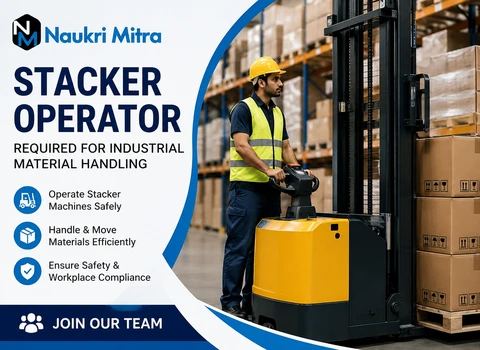
What Does a Stacker Operator Actually Do?
Walk into any large warehouse or factory yard, and you'll notice materials don't move themselves. Someone has to lift, stack, and reposition pallets, drums, coils, or packed goods, often several meters off the ground, without dropping or damaging anything. That someone is usually a Stacker Operator.
Right now, there's a Stacker Operator Required for Industrial Material Handling opening in Hazira, Gujarat, India, listed as a Full-time position. It's a role worth understanding thoroughly before applying, because the day-to-day work is more technical than the title alone suggests.
Why This Job Exists in the First Place
Manual lifting only goes so far. Once material volumes reach a certain threshold, factories and warehouses need a machine that can lift loads vertically and place them precisely on racks or storage bays. That's the gap an equipment operator fills. Without one, inventory piles up on the floor, aisles get blocked, and production slows down.
Hazira sits within one of Gujarat's busier industrial corridors, home to steel plants, chemical units, engineering workshops, and logistics operations. These setups create a steady need for people who can operate stackers and similar material-handling equipment safely.
A Shift, Start to Finish
The work usually opens with a machine check. Nobody starts a shift without first looking over the hydraulics, tires, forks, brake response, and warning lights. Skipping this step is how small faults turn into breakdowns mid-shift.
Once the machine is cleared, the actual movement work begins. A technician might spend the next few hours doing any combination of the following:
- Lifting and stacking pallets or drums onto multi-level racks
- Pulling stored material back down when production needs it
- Sticking to marked lanes and speed limits inside the plant
- Checking in with store supervisors on what needs to move next
- Flagging odd noises, hydraulic leaks, or vibration to the maintenance team
Some shifts are repetitive. Others involve constant back-and-forth as dispatch schedules change. Either way, the operator stays on the machine for most of the working hours.
How the Machine Itself Works
A stacker relies on a hydraulic mast to lift loads straight up, unlike a forklift, which is designed more for carrying materials over short distances. The forks slide beneath a pallet, the hydraulics raise the mast, and the load gets placed on a rack that could be well above head height. In tight warehouse aisles where there's no room to maneuver sideways, this vertical lifting design matters a lot.
Alongside the stacker, operators often handle pallet trucks, weighing scales, and measuring tapes, plus basic hand tools for small adjustments on the floor.
What Employers Are Really Checking For
Certificates help, but supervisors watch how a candidate actually handles the machine. Load balancing, judging height correctly, and staying controlled in narrow aisles matter more than theoretical knowledge alone. An ITI background in a related trade is often preferred, though hands-on experience from a previous warehouse or factory job can count for just as much.
What separates a good operator from an average one usually isn't technical skill at all. It's staying alert through a long shift, working well with the store team, and never cutting corners on safety instructions, even when things get busy.
The Physical Side of the Job
This isn't a desk job. Expect long hours seated on the machine, interrupted by periods of standing to check loads and move around the yard. Decent eyesight and quick hand-eye coordination matter here, since misjudging distance or load height can cause real damage.
Depending on the industry, the floor can get noisy and dusty, and temperatures swing depending on what's being processed nearby. Shift work, including rotational or night shifts, is fairly standard in units that run continuous production.
Safety Isn't Optional Here
Overloading a stacker, ignoring its rated capacity, or rushing through narrow aisles are the kinds of mistakes that cause accidents. Operators are trained to strictly adhere to load limits and keep speeds low in congested areas. Safety shoes, a helmet, a high-visibility jacket, and hand gloves are the usual PPE on the floor.
Most plants also run regular safety briefings and floor inspections, and sticking to these protocols is as much a part of the job as the actual lifting work.
Where New Operators Usually Struggle
Judging load height correctly takes time. So does manoeuvring confidently in a tight aisle without clipping a rack. Most new operators feel this in the first few weeks. Watching an experienced operator work, and practicing slow, deliberate movements instead of rushing, tends to fix this faster than anything else.
A few habits that hold up well over time: keep the machine clean, report even minor faults right away rather than wait, and never skip the pre-shift checklist just because yesterday's shift was uneventful.
Where the Career Can Go From Here
Operators who stay consistent and build a clean safety record often move up to handling higher-capacity equipment or take on supervisory work within the material handling section. Some transition into warehouse coordination, planning inventory movement rather than doing it hands-on. None of this happens overnight, but a steady track record inside the same industry tends to open these doors over time.
Pay for This Position
The Hazira opening is a Full-time role based in Gujarat, India, with a monthly salary of ₹29,000. That figure lines up with what skilled machine-handling positions typically pay in this part of the industrial sector.
What Else Might Come With the Role
Depending on the employer, extras such as PF, ESI coverage, overtime pay, uniforms, and canteen and transport facilities may be part of the package. None of these are guaranteed across every employer, but they're common enough in this line of work to be worth asking about during the interview.