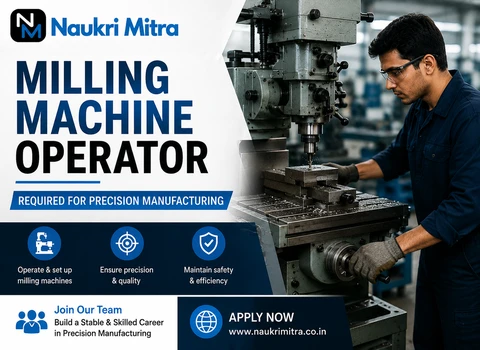
What Does a Milling Machine Operator Actually Do
Walk into any tool room or machining unit, and you'll usually find someone standing at a milling machine, drawing in one hand, micrometer in the other. That's the Milling Machine Operator. The job is about taking a raw block of metal and turning it into a part that matches a drawing, sometimes down to a fraction of a millimeter. It sounds simple until you actually try it.
Why Factories Keep Hiring for This Position
Here's the thing about manufacturing: machines don't run themselves, not even the good ones. A CNC milling center still needs someone to set it up correctly, load the right tool, and catch problems before they ruin the whole batch. Companies making automotive parts, tooling, or general engineering components can't afford a bad batch, so they keep hiring people who know their way around a spindle and a drawing sheet.
A Shift Looks Something Like This
Most days start with the job card. What part, what material, what tolerance. The operator checks the drawing, sets up the fixture, picks the cutter, and dials in the speed and feed. Then the machining starts, and this is where things get interesting - you're watching for chatter, listening to how the cut sounds, checking the surface finish as it comes off.
Somewhere in between, there's measuring. Vernier calipers, micrometers, dial gauges, whatever the part demands. If something's off by even a little, you stop and figure out why before it becomes ten bad pieces instead of one. Toward the end of the shift, there's cleanup, machine oiling, and handover notes for whoever comes next.
What Fills Up the Actual Workday
- Reading engineering drawings, sometimes revised ones with tight new tolerances
- Setting jigs and fixtures so the part doesn't move mid-cut
- Running conventional or CNC milling machines
- Measuring finished pieces against spec
- Swapping tools when they've worn down
- Keeping production logs updated, not just at the end of the day
- Sticking to whatever SOP the company follows, even when it feels slower
The Kind of Places You'd Be Working In
Tool rooms and precision engineering workshops hire heavily for this role. So do automobile component units and general machining shops. Some setups still rely mostly on manual milling machines; others have moved to CNC; and a fair number use both side by side. It's also common to find EDM (Electrical Discharge Machining) equipment nearby, brought in for shapes that a milling cutter just can't reach.
Machines and Instruments You'll Get Familiar With
Beyond the milling machine, expect surface plates, height gauges, bore gauges, and, on more advanced setups, coordinate measuring machines for parts with complex geometry. Understanding how the cutter actually removes material - and why a cutter that works fine on mild steel might struggle on a hardened alloy - separates someone who's just operating a machine from someone who genuinely understands the process.
Training and Background That Employers Look For
Employers generally prefer candidates with some machining or toolroom training. An ITI in a machining-related trade covers the basics well. A Diploma in Mechanical or Tool and Die Engineering offers greater depth, especially for more complex work. Honestly though, hands-on exposure to EDM machines, engineering drawings, and precision instruments often counts for just as much as the certificate itself. You learn tolerances by working with them, not by reading about them.
What the Job Asks of You Physically
This isn't a desk job. You're on your feet most of the shift, lifting workpieces, and staying alert around a machine that doesn't pause for a distracted moment. There's noise, there's coolant, there's the occasional metal dust in the air. Shift work is fairly normal in this line of work, since many production units run round the clock, so operators should be ready for rotating schedules or fixed night shifts depending on where they land.
Safety Isn't Optional Here
Safety glasses, gloves rated for machine work, and steel-toed shoes are standard. Ear protection comes into play depending on how loud the shop floor is. Beyond the gear, it's the habits that matter more - never walking away from a running machine, keeping loose clothing well clear of a rotating spindle, wiping up coolant spills before someone slips on them. Lockout procedures before any maintenance work aren't a formality; they're the difference between a routine fix and an accident.
Where New Operators Usually Struggle
Hitting tight tolerances while the production line is breathing down your neck isn't easy, especially when a tool starts wearing halfway through a batch, and nobody notices right away. Switching between materials adds another layer - mild steel and a hardened alloy don't behave the same way under the same cutting parameters. And reading a dense engineering drawing for the first few weeks can feel overwhelming. It gets easier. Most operators say it clicks within a few months of steady practice.
Where This Role Can Take You
Plenty of operators start out as helpers, learning the machine before they're trusted to run it on their own. From there, it's common to move into independent operation, then toward CNC programming, quality inspection, or eventually a shift supervisor role in the same tool room or production unit. The operators who get noticed are usually the ones who read drawings fast and measure accurately without being told twice - that reputation tends to open doors on its own.
Pay and What Else Might Come With It
This particular Milling Machine Operator position, based in Coimbatore, Tamil Nadu, India, pays ₹27,000 a month and is a full-time role. Some employers add extras on top - overtime pay, PF, ESI, an annual bonus, uniforms, transport, or canteen access - though what's actually offered varies from company to company, so it's worth confirming directly during the hiring process.
Should You Go For This
If precise, hands-on work appeals to you more than sitting behind a screen, this is a solid entry point into India's manufacturing world. Coimbatore has a genuinely strong engineering and machine tool base, which means there's steady demand here - for freshers coming out of an ITI or diploma program, and for experienced hands looking for their next step up.