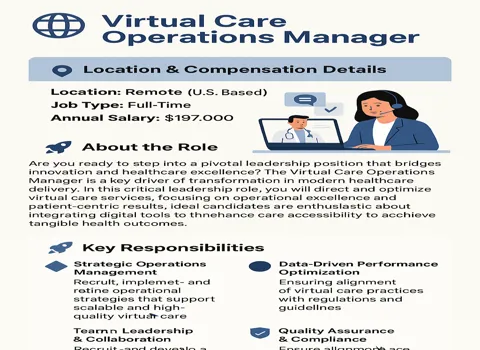
Virtual Care Operations Manager
Job at a Glance
Virtual care has changed how people access healthcare—but behind every smooth video consultation or quick follow-up lies a carefully managed system. This role is responsible for making that system work reliably, day after day, for both patients and care teams.
With an annual salary of $197,325, this remote opportunity places you at the center of digital healthcare operations. The work isn’t abstract—it directly affects whether a patient receives timely support, whether providers can focus on care rather than logistics, and whether the entire experience feels seamless or frustrating.
Role Significance
Healthcare doesn’t slow down when it moves online—it becomes more complex. Multiple systems, distributed teams, and varying patient needs all intersect at once. Without strong operational leadership, small inefficiencies can quickly grow into real barriers to care.
This position exists to bring clarity and control to that complexity. By improving workflows, aligning teams, and refining processes, the Virtual Care Operations Manager ensures that remote healthcare services remain dependable, efficient, and patient-focused.
The result shows up in practical ways: fewer missed appointments, faster response times, and a more consistent experience for everyone involved.
What You’ll Do Daily
The rhythm of the role combines oversight with problem-solving. Some days begin with reviewing performance dashboards—looking at appointment flow, patient wait times, and provider availability. Other moments are spent working directly with teams to understand what’s working and what isn’t.
Instead of simply tracking issues, the focus is on resolving them. A recurring delay in patient onboarding may necessitate reworking intake steps. A drop in appointment completion rates could prompt adjustments in scheduling or communication.
Collaboration is constant. Clinical teams rely on clear processes, while technical teams depend on accurate feedback. Bridging that gap is a key part of the day-to-day work.
Over time, these small improvements compound into smoother operations, stronger care delivery, and better outcomes across the board.
Must-Have Skills
This role calls for someone who understands how systems behave under pressure. Experience in healthcare operations, telehealth services, or digital health environments provides a strong starting point.
Managing distributed or remote teams is an important part of the job, so clear communication and steady leadership matter. The ability to explain operational changes in a way that makes sense to both clinicians and technical staff is especially valuable.
Comfort with data is equally important. Reading performance metrics, identifying patterns, and making informed decisions based on those insights help keep operations efficient.
A solid grasp of healthcare compliance, patient privacy standards, and workflow design ensures that improvements are not only effective but also safe and compliant.
Work Format
This position is fully remote, designed for professionals who can stay organized without constant supervision. The flexibility is real—but so is the responsibility to keep operations running smoothly across time zones and teams.
The environment is collaborative, even without a physical office. Regular check-ins, shared dashboards, and cross-functional discussions help maintain alignment. At the same time, there’s plenty of space for focused, independent work.
The pace can shift quickly, especially when patient demand increases or new services are introduced. Being able to adapt without losing structure is key to succeeding here.
Tools & Software
Daily work revolves around platforms that support virtual care delivery. Telehealth systems are central, enabling real-time patient interactions. Electronic Health Records (EHR) systems manage clinical data and documentation.
Project management tools help track initiatives and keep teams aligned, while communication platforms ensure quick coordination across departments. Analytics tools provide visibility into operational performance, helping guide decisions on scheduling, resource allocation, and patient flow.
Familiarity with these tools—and the confidence to learn new ones quickly—makes it easier to maintain efficiency in a fast-moving environment.
Example Scenario
A sudden increase in patient volume begins to strain the system. Appointment slots fill up quickly, and providers start running behind schedule. Patients experience longer wait times, and frustration builds.
Instead of applying a quick fix, the situation is examined closely. Data reveals that the issue isn’t just demand—it’s how appointments are spaced and how patients move through intake.
By adjusting scheduling intervals and simplifying pre-visit steps, the flow improves. Within a short period, providers regain control of their time, and patients experience shorter waits.
This kind of situation is common—and handling it well is what defines success in the role.
Who This Job Suits
This role fits someone who naturally looks for better ways to do things. It’s ideal for a professional who enjoys improving systems, solving practical problems, and seeing the direct results of their work.
People who do well here tend to be calm under pressure, detail-oriented, and comfortable making decisions based on both data and real-world context. They don’t wait for perfect conditions—they act, adjust, and refine as they go.
Experience in virtual care operations, healthcare management, or service delivery environments is highly relevant. Just as important is the ability to stay connected with people while managing complex systems behind the scenes.
Ready to Apply?
If you’re drawn to work that quietly powers meaningful outcomes, this role offers exactly that. Every improvement you make helps someone access care more easily and helps a provider do their job more effectively.
Step into a role where operational thinking meets real-world impact—and where your decisions shape how care is delivered every single day.