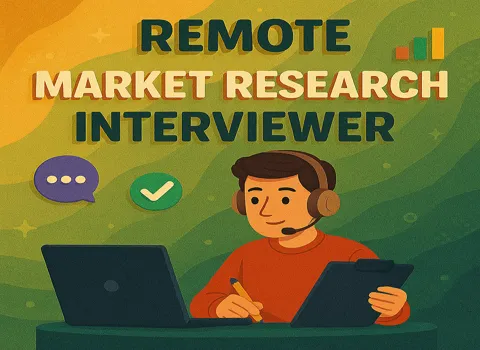
Remote Market Research Interviewer Opportunity
Role Highlights
Every decision a company makes about a product or service usually starts long before launch. It begins with people talking—sharing frustrations, preferences, small habits, and honest reactions that rarely show up in dashboards. This role sits inside those conversations.
As a Remote Market Research Interviewer, you help capture real voices and turn them into insights useful to teams shaping future products. The work is remote and offers a yearly salary of $73,250, but its real value lies in the influence it carries.
Instead of guessing what customers want, businesses rely on structured conversations like the ones you lead. That’s where your role becomes quietly important.
How You Shape Decisions
Most insights don’t come from dramatic answers. They come from small details—a pause before responding, a change in tone, or a story that reveals a hidden frustration.
Your conversations help uncover those details. Each interview informs research that guides product improvements, customer experience changes, and strategic planning.
You’re not just collecting responses. You’re helping translate everyday experiences into something teams can actually act on. That translation is what makes this role valuable.
What a Typical Day Feels Like
There’s a rhythm to the work, but it doesn’t feel mechanical. You’ll spend a large part of your day speaking with people from different backgrounds, each with their own perspective on products, services, or digital experiences.
Some conversations are straightforward. Others take time to open up. The skill lies in knowing when to listen quietly and when to gently guide the discussion forward.
Between interviews, you’ll review discussion guides, adjust phrasing as needed, and ensure each conversation stays aligned with research goals. Notes and recordings matter, but accuracy matters more.
Over time, you start noticing patterns in how people think and respond—patterns that help improve the quality of every interview that follows.
What Helps You Succeed
This role doesn’t depend on complex technical expertise. It depends more on how you communicate and how you listen.
Being able to hold a natural conversation while staying neutral is essential. You’re there to understand, not to influence.
Curiosity also plays a big role. The best interviewers don’t just follow the questions—they pay attention to what’s not being said and gently explore when something feels important.
Familiarity with research interviews, surveys, or customer-focused conversations helps, but it’s the consistency and attention to detail that really define success here.
How the Work Is Structured
Even though the role is remote, it has a clear structure. Interviews follow set guidelines, and research teams provide direction for each project.
You’ll manage your own schedule, but there’s still a sense of alignment with broader research timelines. Communication happens through digital tools, and coordination ensures everyone stays on the same page.
The environment values clarity and steady output. It’s less about speed and more about getting accurate, reliable responses that research teams can trust.
Tools That Support Your Work
Your daily work is supported by a mix of digital tools designed to make interviews smoother and more organized.
Video conferencing platforms are used for live conversations. Survey systems help structure questions. Data tools and dashboards allow you to record responses and keep everything organized.
You may also use transcription support tools or simple CRM-style systems that track participant details across studies.
These tools don’t replace your judgment—they support it, helping ensure consistency across all interviews.
A Real Situation You Might Encounter
Imagine a study exploring why users stop using a subscription app after a short period.
One respondent joins the interview and initially gives short answers. Nothing unusual stands out at first. But instead of moving on quickly, you slow the pace and let the conversation breathe.
Gradually, the person opens up. They mentioned that the app felt confusing during setup and that they weren’t sure how to get started. That small detail turns out to be part of a larger pattern across multiple interviews.
Later, that insight informs a redesign of the onboarding process, making it simpler for new users. What started as a casual conversation ended up improving the product experience for thousands of people.
Who Fits Well Here
This role tends to suit people who enjoy structured conversations but don’t want them to feel robotic.
If you’re someone who naturally pays attention to how people think, respond, and make decisions, you’ll likely find this work engaging.
It also fits well for individuals interested in consumer behavior, qualitative research, or remote communication roles.
What matters most is not speed or volume—it’s the ability to stay attentive, consistent, and thoughtful across every conversation.
Moving Forward
Working in this role means being part of something that influences how companies understand real people. Not through assumptions, but through direct conversations.
Each interview adds another layer of understanding. Over time, those layers build into insights that shape better products and better experiences.
If you enjoy conversations that lead to meaningful outcomes, this role offers a steady way to turn that strength into impact.