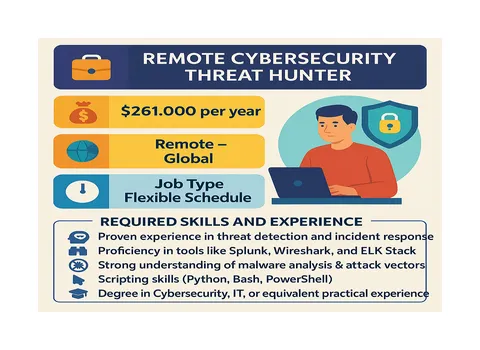
🛡️ Remote Cybersecurity Threat Hunter
💼 Job Type: Full-Time
🌍 Location: Remote
💰 Salary: $261,000 per year
🕰️ Schedule: Flexible working hours
📅 Experience Level: Senior-level cybersecurity professionals
🎯 Lead the Digital Frontline – Your Mission
Are you an experienced, vigilant, and forward-thinking cybersecurity professional who thrives in dynamic digital environments? We seek a
Remote Cybersecurity Threat Hunter to join our elite, globally distributed cybersecurity team. This is not just a job—it’s a mission-critical opportunity to take a proactive role in defending critical digital infrastructure from the most advanced cyber threats. This position empowers you to anticipate, detect, and neutralize malicious activities before they compromise our systems, data, and customers.
With industry-leading compensation, a flexible
remote schedule, and unmatched opportunities for professional advancement, this role is designed for those ready to lead from the digital frontlines.
🚀 Why This Role Matters
🔐 Your Impact on Cyber Resilience
🔸
Proactive Threat Neutralization – Instead of waiting for breaches to occur, you will actively search for threats, vulnerabilities, and anomalies across networks and endpoints. Your work will prevent disruptions before they start.
🔸
Protecting Digital Trust – Your role is essential to maintaining stakeholder trust. Every analysis you conduct and every threat you uncover contribute to preserving our digital integrity and public confidence.
🔸
Innovative Strategy Contribution – Collaborate directly with red teams, SOC professionals, forensic analysts, and engineers to improve detection mechanisms, build custom scripts, and shape threat intelligence strategies.
🧠 What You'll Be Doing
🌐 Threat Hunting & Intelligence
- 🟢 Design and execute proactive threat-hunting missions across enterprise systems
- 🟣 Leverage threat intelligence feeds and adversarial emulation to identify suspicious activity
- 🔵 Identify indicators of compromise (IOCs), techniques, and tactics (TTPs) in alignment with MITRE ATT&CK
- 🟠 Develop threat hypotheses based on behavior analysis and test them using a combination of manual and automated tools
🔍 Data-Driven Detection
- 🟡 Analyze logs, telemetry, and network flows using SIEM (Splunk, QRadar, Elastic)
- 🟢 Perform memory, packet, and disk analysis to detect anomalies or indicators of malware
- 🔴 Utilize endpoint detection and response (EDR/XDR) tools for real-time threat identification
- 🟣 Build and refine detection use cases, rules, and playbooks
🤝 Collaborative Intelligence Sharing
- 🔵 Coordinate with red teams, penetration testers, and cloud security architects
- 🟠 Partner with incident response to triage escalated alerts and contribute to threat containment
- 🟡 Prepare technical documentation and brief executive stakeholders with clarity and impact
🚨 Incident & Response Support
- 🟣 Engage during critical security events to provide deep-dive threat analysis and context
- 🔵 Participate in post-incident reviews to identify missed detection opportunities
- 🟠 Contribute to the refinement of incident response procedures
🧩 What We’re Looking For
📚 Professional Experience
- 🟢 7+ years in cybersecurity with at least 3+ years focused on threat hunting or blue team operations
- 🔵 Deep understanding of threat actor methodologies, cyber kill chains, and attack simulation tools
- 🟣 Strong record of developing custom scripts, queries, or signatures for detection
🛠️ Tools & Environments
- 🔴 Experience with SIEM and SOAR platforms (e.g., Splunk, Sentinel, QRadar)
- 🟠 Competency with EDR tools like CrowdStrike, Carbon Black, SentinelOne
- 🟡 Skilled in scripting languages like Python, PowerShell, and Bash for automation and analysis
- 🟢 Familiarity with cloud environments (AWS, Azure) and container security tools
🎓 Education & Certifications
- 🟣 Bachelor’s or Master’s degree in Cybersecurity, Computer Science, or a related field
- 🔵 Preferred certifications: GIAC (GCTI, GCFA), OSCP, CEH, CISSP, or equivalent
🧠 Behavioral Competencies
- 🟠 Insightful problem-solver with a meticulous eye for patterns and discrepancies
- 🔵 Ability to thrive in high-pressure environments and make timely decisions
- 🟡 Strong communication and technical reporting skills
- 🟣 Passionate about continuous learning, threat research, and process improvement
📈 Growth, Impact, and Empowerment
🚀 Career Advancement
🌟 Culture of Innovation
- 🟠 Work in a mission-driven environment where your input is respected and your innovations matter
- 🔴 Collaborate with some of the brightest minds in cybersecurity and threat intelligence
- 🟡 Engage in open-source research initiatives and contribute to cyberdefense communities
🌍 Flexibility and Balance
- 🟣 Remote-first model lets you work from anywhere in the world
- 🟢 Design your workday around personal productivity rhythms
- 🔵 Annual retreats and virtual team-building experiences to foster connection
🧭 The Path Forward
This position provides a unique opportunity for cybersecurity professionals to advance into influential roles within the cybersecurity domain. Whether your aspirations lead you to oversee enterprise-wide information security or specialize in advanced fields such as adversarial simulation, forensic analysis, or digital risk management, this role provides a stepping stone to future leadership and niche expertise.
As part of our team, you’ll be empowered to create change, shape security policies, and influence global cyber resilience from the front. The knowledge, tools, and mentorship at your disposal will push you beyond conventional blue teamwork and into cutting-edge cyber defense.
✅ Ready to Redefine Cybersecurity?
If you're passionate about advancing the cybersecurity frontier, driven by data, and eager to take control of your next big challenge, we want you on our team. Join us on our critical mission to detect, deter, and defeat cyber threats in real-time.
🎯 Take the next step in your career today — apply now and become a guardian of the digital world.