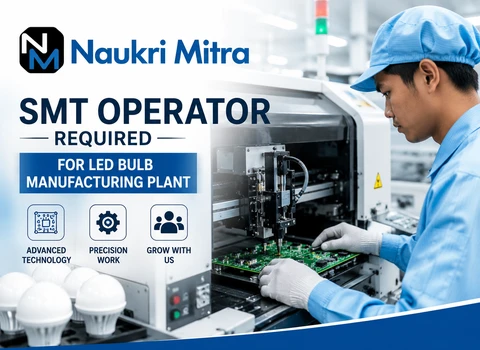
What an SMT Operator Actually Handles Day to Day
Pop open any LED bulb, and you'll find a small circuit board doing all the real work. Getting the tiny diodes, resistors, and drivers onto that board is a job for machines, not hands, and someone has to run those machines. That's the SMT Operator — SMT stands for Surface Mount Technology, and the operator is the person watching the line, catching problems, and keeping boards moving at the right speed and quality. This opening is for a Full-time role at an LED bulb manufacturing plant in Noida, Uttar Pradesh, and it's the kind of job that can genuinely anchor a career in electronics production if you take it seriously.
Why This Job Exists in the First Place
Component placement on a modern circuit board isn't something a person could do by hand at any real scale — the parts are too small, and there are too many of them per board. So plants run SMT lines instead, and those lines need someone tracking placement accuracy, solder quality, and machine output. Skip that step and a whole batch can fail testing later, which means rework, wasted material, and missed targets. That's the gap this role fills.
What a Shift Looks Like
Most shifts start with a handover — checking what the previous operator left running, confirming machine settings, and loading fresh component reels. Then comes a first-piece check before the line goes into full production. Once it's confirmed good, the real work is watching: feeders, solder paste, the pick-and-place head laying components exactly where they belong. It sounds repetitive on paper. In practice, no two shifts run identically — feeders jam, reels run low at inconvenient times, and small adjustments happen constantly.
The Core of the Job
Strip away the job-posting language and here's what fills the hours:
- Loading and swapping component reels as they run out
- Watching the pick-and-place machine for misalignment or dropped parts
- Spot-checking solder paste printing before boards move ahead
- Logging output numbers and rejects for each shift
- Flagging faults to maintenance before small issues become line stoppages
- Keeping the machine area clean, since dust and debris cause more defects than people expect
Where Operators End Up Working
LED and lighting plants hire for this role, obviously, but so do electronics assembly units, consumer appliance factories, and PCB workshops more broadly. The machines and skills overlap enough that someone trained on one SMT line can usually move into another type of electronics plant without starting from zero.
The Machines and Tools You'll Get Familiar With
Expect to work around the pick-and-place machine, a solder paste printer, a reflow oven, and often an automated optical inspection (AOI) unit that catches defects the eye might miss. A multimeter comes in handy for quick continuity checks, and a magnifying lamp is standard for anyone inspecting fine solder joints — some of these boards have joints smaller than a pinhead.
Skills That Actually Matter Here
Sharp eyesight helps more than people expect, and steady hands matter when components are this small. Beyond that, it comes down to knowing basic electronic components well enough to spot when something's off, staying patient through long inspection stretches, and being comfortable around computer-controlled equipment rather than intimidated by it. Operators who catch a bad board early save the whole shift a headache later.
Who Tends to Fit This Role
ITI graduates from electronics or electrical trades are a natural fit. Diploma holders in electronics engineering do well too. Freshers aren't ruled out — plenty of plants are willing to train someone with the right attitude even without prior SMT-line experience, though having touched a PCB assembly line before does help during the first few weeks.
The Physical Side of the Job
You're on your feet for most of the shift. The repetitive hand movements and the required visual focus can tire the eyes faster than people expect in their first week. Shift work is standard in manufacturing, so operators need to be okay with either a fixed schedule or rotating shifts, depending on how the plant runs its floor.
Safety Isn't Optional Around These Machines
An ESD wrist strap is usually mandatory — one static discharge can quietly ruin a component that looked fine a second earlier. Safety shoes are standard, and gloves come into play near the reflow oven where heat is a factor. None of this is bureaucratic box-ticking; static damage and burns are both real risks on an SMT line if shortcuts get taken.
Where Experience Can Take You
Operators who stick with it and learn the machines well often move into line lead positions, quality inspection, or maintenance technician roles within the same plant. The path isn't automatic, but plants do notice who can troubleshoot a fault without waiting for someone else to fix it, and that's usually who gets considered first when a senior spot opens up.
Pay and What Else Might Come With It
This position in Noida, Uttar Pradesh pays ₹31,200 a month. Beyond the base salary, plants sometimes add overtime pay, PF, ESI, a festival bonus, uniforms, or transport and canteen access — none of that is guaranteed across every employer, but it's common enough in this line of work to be worth asking about during an interview.