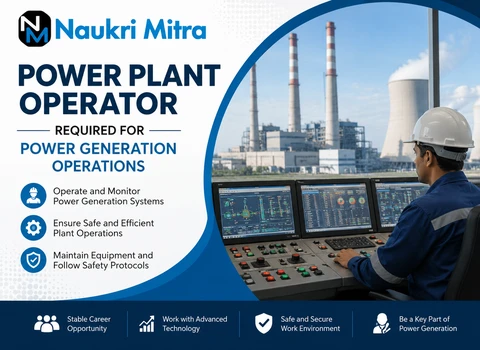
So What Does This Job Really Involve?
Ask ten people what a power plant operator does, and half of them will guess "sits and watches dials." There's some truth to that, but it's only a slice of it. The role — advertised here as Power Plant Operator Required for Power Generation Operations, based in Korba, Chhattisgarh, India — mixes control-room monitoring with hands-on inspection work around boilers, turbines, and cooling systems. Korba itself has long been tied to thermal power generation, so this isn't an unusual line of work to find locally.
What makes it worth understanding properly, before applying, is that it's not a passive job. You're not just observing. You're catching problems early, sometimes before instruments even flag them clearly.
Why Does This Position Even Exist?
Because electricity generation can't have gaps. A boiler pressure spike at 3 a.m. doesn't wait for the day shift to arrive. Plants need someone present around the clock who can notice a temperature reading creeping upward and act before it becomes an actual failure. Skip that, and you risk a shutdown that could affect an entire grid section — not just one unit. That's really the whole justification for hiring operators in the first place.
A Rough Sketch of the Shift
No two shifts are identical, but there's a pattern most operators fall into. It usually starts with the handover — reading what the outgoing team logged, asking what's pending. From there:
- control panels and digital meters get watched closely
- temperature, pressure, flow readings get noted at set times
- equipment gets started up or shut down on instruction
- anything odd — a vibration, a smell, a leak — gets reported without delay
- maintenance crews get support when repairs are scheduled
This is full-time work. Punctuality isn't a soft expectation here; a plant genuinely cannot run with gaps in coverage.
Beyond the Screens
Here's something people underestimate: a lot of this job happens on foot. Operators walk the floor, check pipelines, inspect valves, listen for sounds that shouldn't be there. A faint hiss near a valve joint might mean nothing, or it might mean a seal is failing — either way, it gets written down and reported. Speaking of which, logbooks matter more than they seem to at first glance. Engineers use those entries weeks later to spot slow-building patterns, so a rushed or careless log can genuinely cause confusion down the line.
Where Jobs Like This Tend to Be Based
Thermal power stations are the obvious answer, but not the only one. Captive power units attached to steel plants or cement factories hire for similar roles too, and so do other industrial generation setups scattered across Chhattisgarh and nearby states. Some run three rotating shifts around the clock. Others manage on two, depending on how much load they're carrying at any given time of year.
The Machines You'll End Up Knowing Inside Out
Boilers. Turbines. Generators. Condensers. Cooling towers. These stop being unfamiliar terms fast once you're on the floor daily. Pressure gauges, thermometers, flow meters, vibration sensors — checked constantly, sometimes hourly. Small adjustments are handled directly by the operator with basic hand tools; anything bigger usually calls in maintenance technicians armed with spanners, torque wrenches, and lifting equipment.
What Separates a Good Operator From an Average One
Technical knowledge gets you in the door. It's not what keeps you good at the job in the long term. A few things tend to matter more once you're actually on the floor —
- Reading a gauge in half a second, not three
- Understanding electrical circuits and interlocks well enough to trust your own judgment
- Not freezing up when an alarm goes off unexpectedly
- Handing off a shift clearly, so the next person isn't guessing
- Sticking to procedure, even at 4 a.m. when nobody's watching
Education That Actually Opens Doors Here
Most employers want an ITI certificate—Electrical, Mechanical, or a closely related field. A Diploma in Mechanical or Electrical Engineering helps, especially if you're eyeing a supervisory role down the road. But talk to anyone who's spent a decade doing this work, and they'll say the same thing: knowing how to read an engineering drawing, or handle precision measuring instruments properly, counts for just as much as whatever's printed on the certificate.
What It Does to Your Body
You'll be standing and walking far more than sitting. Stairs to reach elevated equipment, occasional lifting, long stretches near boiler sections where the heat is genuinely uncomfortable. Add constant background noise on top of that. And because power generation never really stops, night shifts are part of the deal — most people need a few weeks before their sleep schedule stops fighting them.
Safety Isn't Optional Here — Literally
Helmets, safety shoes, ear protection, fire-resistant clothing depending on the section — these aren't suggestions. Lockout-tagout before touching anything live, routine gas checks, and fire drills that are actually taken seriously. None of this is bureaucratic box-ticking. It's the reason accidents in well-run plants stay rare.
Where New Operators Usually Struggle
Honestly? It's rarely the technical side. It's staying sharp during the 2 a.m. stretch of a night shift when an alarm suddenly goes off, and your body wants to be asleep. Heat exhaustion near boiler units surprises many newcomers, as does just how loud the floor stays for hours at a stretch. Operators who take the time early on to actually learn the emergency shutdown sequence — properly, not just enough to pass a check — tend to handle real incidents with far less panic later.
Where This Can Lead
Put in a few solid years, and senior operator or shift-in-charge roles start to become realistic, where you're coordinating an entire team's shift rather than just your own station. Plants keep upgrading their control systems, too, so operators who stay current with newer technology and safety standards tend to advance faster than those relying purely on years of service.
The Salary Side of Things
This is a full-time role based in Korba, Chhattisgarh, India, paying ₹38,000 a month. Beyond that base figure, some employers throw in overtime pay, PF, ESI, uniforms, transport, or canteen access — though none of that is guaranteed across the board, and it's worth asking directly during hiring rather than assuming it comes standard.
Before You Actually Apply
Get your electrical and mechanical basics solid — interviewers will often test this on the spot, not just ask about it. Practice reading technical manuals until it feels routine rather than like homework. And if there's any way to spend time at an industrial training center or take up a short apprenticeship first, do it. It makes the jump into full-time plant work a lot less jarring than walking in cold.