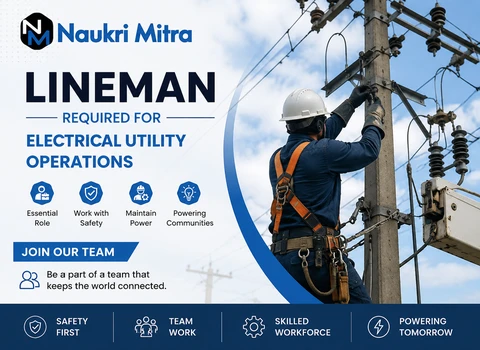
What It Actually Means to Work as a Lineman
Somebody has to climb the pole after a storm knocks down a line. Somebody has to check why a transformer keeps tripping at 2 a.m. That work falls to linemen, and this
Lineman Required for Electrical Utility Operations opening in Vadodara, Gujarat, is exactly that kind of job.
If you're new to this field, here's the short version: a lineman installs, inspects, and repairs the wires and equipment that carry electricity from substations to homes and businesses. It's outdoor work, it's physical, and when something breaks, people notice fast.
The Reason This Role Keeps Getting Advertised
Cables sag over time. Insulators crack. Monsoon winds bring down conductors that were fine the week before. Utility operations can't just wait for things to fail on their own schedule, so they keep hiring people who can get to a fault, figure out what's wrong, and restore power without making things worse. That's really the whole reason this trade exists as a full-time occupation rather than something handled occasionally.
How a Shift Usually Goes
Mornings often start at the yard, picking up tools and hearing what jobs are lined up for the day. Some of it is routine — patrolling a stretch of line, tightening a loose connector, replacing a worn insulator. Then a fault call comes in, and the whole day gets reshuffled. You go where the problem is.
A few things show up again and again in the job:
- Walking or driving line routes to spot damage before it causes an outage
- Stringing new conductor or repairing broken sections
- Making joints and terminations that won't fail under load
- Connecting or servicing distribution transformers
- Writing up what was done, and flagging anything that still needs attention
Where the Work Actually Happens
In and around Vadodara, this could mean anything from a quiet residential feeder to a line running past a busy commercial stretch. Some days the job site is a pole on a roadside. Other days it's a distribution substation or a transformer yard tucked behind an industrial plot. The setting changes; the core task doesn't.
Gear You'll Actually Use
Nobody does this job with bare hands and a wrench. Expect to work with:
- Insulated pliers, cutters, and spanners rated for live-line safety
- A line tester and a multimeter, used constantly to confirm a circuit is actually dead before touching it
- A megger, for checking insulation resistance on cables and equipment
- Come-along clamps and pulling gear for tensioning conductors
- Earthing rods, discharge sticks, ladders, and — depending on the assignment — a bucket truck
Knowing why you earth a line before working on it, or what a low megger reading is actually telling you, matters more than being able to recite it in an interview. It's the kind of thing you understand properly only after doing it a few times.
What Employers Look For
A basic grasp of electrical circuits and transformer operation is expected, but so is judgment — being able to look at a joint and tell it's about to fail, or read a single-line diagram without someone walking you through it. An ITI in the Electrician or Lineman trade is the usual entry point. Diploma holders in Electrical Engineering also get considered, often for roles that lean more toward supervision down the line.
The Physical Side Nobody Sneaks Past
This is a full-time role, and it asks a lot of your body — climbing, standing for long stretches, working at height in Gujarat's heat or through monsoon rain. Night shifts happen too, especially when a fault needs fixing before morning. It isn't desk work, and it was never going to be.
Safety Isn't Optional Here
Every experienced lineman has a story about the one time someone assumed a line was dead and it wasn't. That's why testing before touching, double-checking isolation, and never skipping earthing procedures aren't treated as suggestions. Standard protective gear includes a helmet, insulated gloves, a safety belt for pole work, and high-visibility clothing — worn every time, not just when a supervisor is watching.
What Makes the Job Hard
Heat, sudden rain, awkward access to a pole wedged between buildings — none of it is rare. Fault restoration also comes with time pressure, since customers without power don't wait patiently. Staying sharp after a long, tiring shift is a skill in its own right, and it takes time to build.
Growing Within the Trade
Most people start as helpers or junior linemen. With a few years of fieldwork behind them, and comfort handling higher-voltage systems, moves toward senior lineman or line supervisor become realistic. Some eventually take on substation-in-charge responsibilities, coordinating crews rather than only working the line themselves.
Pay and What Might Come With It
The role pays ₹30,000 per month, full-time, and is based in Vadodara, Gujarat, India. Beyond the salary, some employers offer overtime pay, PF, ESI coverage, uniforms, or transport and canteen facilities — but these vary by employer and shouldn't be assumed without confirming directly.