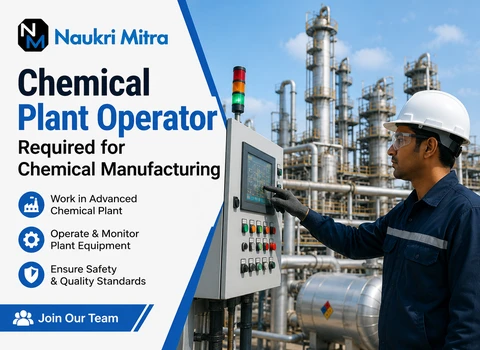
Chemical Plant Operator Required for Chemical Manufacturing
Walk into any chemical manufacturing unit, and you'll notice the same thing: tanks humming, pipelines running overhead, gauges flickering on a control panel somewhere. None of it runs on its own. There's a Chemical Plant Operator position open right now at a chemical manufacturing unit in Ankleshwar, Gujarat, India — full-time, paying ₹34,000 a month. If you're trying to figure out whether this kind of work suits you, here's what it's actually like on the ground.
The Job, Stripped of Jargon
Strip away the technical language and a plant operator's job comes down to this: keep the equipment running the way it's supposed to. Reactors, distillation columns, mixing vessels, storage tanks — whichever machines the plant uses to turn raw material into finished chemical product, the operator is the one watching them, adjusting them, and catching problems before they turn into bigger ones.
Why This Role Exists in the First Place
Chemical processes don't forgive carelessness. A pressure reading off by a small margin, a valve left open a few seconds too long — either one can spoil an entire batch, or worse. That's the real reason manufacturing units keep hiring for this position year after year. It isn't a role you can hand to someone untrained and hope for the best.
What a Shift Actually Looks Like
The day starts with a handover — whoever's coming off shift tells you what happened, what to watch, what's still pending. From there it's rounds: checking valves, reading instrument panels, adjusting flow where needed. Samples get pulled and sent for testing. If something looks even slightly off, the lab technician or shift supervisor is pulled in immediately rather than waiting to see if it resolves on its own. Before the shift ends, you pass it all forward to the next person.
What the Role Involves Day to Day
- Starting up, running, and shutting down reactors, pumps, and mixing equipment
- Reading pressure gauges, thermometers, flow meters, and level indicators
- Adding chemicals or raw materials in the right order and the right amount
- Keeping production logs and batch records accurate and current
- Flagging leaks, odd smells, or equipment trouble the moment they show up
- Working alongside maintenance staff during repairs or planned shutdowns
None of these happen in isolation — a missed log entry today can cause confusion for the next operator tomorrow, so consistency matters more than speed here.
Where This Kind of Work Happens
Plants like this exist across petrochemical units, dye and pigment manufacturing, and specialty chemical production sites. Gujarat has built a genuine cluster of such industries over the decades, and Ankleshwar in particular has a longstanding presence in chemical manufacturing, which keeps demand for trained operators fairly steady in the region.
The Machines and Instruments You'll Handle
Reactors, centrifuges, filter presses, boilers — the exact mix depends on what the plant produces. Alongside the larger machinery, operators constantly use handheld instruments like pH meters and pressure gauges, almost without thinking after a while. A growing number of plants also run DCS- or SCADA-based control systems, so operators who are comfortable navigating a digital panel alongside manual controls tend to adjust more quickly.
Skills That Actually Get Used
Knowing how a reaction is supposed to behave, and recognizing when it isn't, matters more than memorizing procedure manuals. A sound that's slightly off, a smell that wasn't there yesterday — these are the signals experienced operators pick up on, often before an instrument confirms anything. Basic computer skills for logging data help too, along with a habit of following written procedure even when a shortcut seems tempting.
The Kind of Background Employers Look For
Most employers prefer an ITI certificate in a relevant trade, or a diploma in chemical engineering. That said, freshers with solid technical training aren't ruled out — plenty of plants are willing to train someone who shows up with the right attitude and a basic grasp of the fundamentals. What tends to stand out on a resume is hands-on exposure: time spent working with actual plant machinery, participating in safety drills, or handling batch documentation during an apprenticeship, rather than classroom learning alone.
What the Body Goes Through
Expect to be on your feet for long stretches, climbing platforms to check tank levels, occasionally lifting containers or materials. Since most chemical plants run round the clock, this full-time position may involve rotating shifts, including night duty. Reasonable physical stamina helps, and so does a willingness to adjust your routine to changing shift timings with little notice.
Safety Isn't a Checkbox Here
Every operator on the floor wears PPE — safety goggles, gloves, helmets, chemical-resistant aprons or suits, depending on which part of the plant they're working in. Lockout-tagout procedures during maintenance aren't optional; gas masks are worn near vapor-prone areas; and a spill is reported the second it happens, not after someone finishes what they were doing. These aren't arbitrary rules; they're what keeps a bad day from becoming a genuinely dangerous one.
What Makes the Job Hard
Strong chemical odors, heat radiating off reactors, the constant mental alertness a long shift demands — none of it disappears just because you've done the job for years. Emergencies are rare, but when they happen, they test how well you actually know your procedures, not how well you can recite them. The operators who last in this field are usually the ones who don't get sloppy just because a shift feels routine.
Where the Job Can Lead
A few years of consistent, careful work can move an operator into a senior operator role, or eventually shift-in-charge, overseeing a bigger section of the plant and guiding newer hires. Picking up additional certifications in safety or process control tends to speed this along, and most of that growth happens without ever leaving the manufacturing floor.
Salary and What Might Come With It
This particular position, based in Ankleshwar, Gujarat, pays ₹34,000 a month for full-time work. Beyond the base pay, some employers offer overtime, PF, ESI, an annual bonus, uniforms, or transport and canteen facilities — though these differ from company to company, so it's worth confirming directly with the employer rather than assuming they're included.