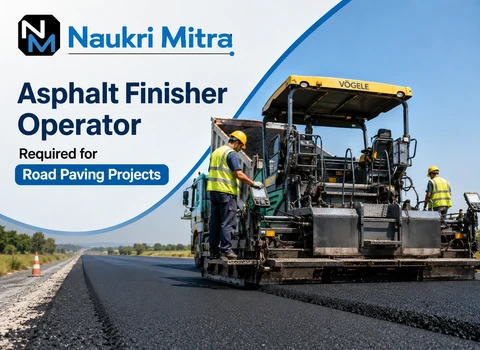
What an Asphalt Finisher Operator Actually Does
Drive on any newly paved road, and you're seeing the result of an asphalt finisher operator's work. This full-time position, based in Surat, Gujarat, involves operating the paver finisher machine to spread hot-mix asphalt across a road surface. It sounds simple until you realize how much depends on getting the thickness, speed, and temperature right all at once.
A Morning on the Paving Crew
Before any asphalt gets laid, there's a routine to follow. Hydraulic fluid, fuel, hopper condition, screed plates - all of it gets checked first. Then tipper trucks start arriving with hot mix, and the real work begins.
- Guiding the paver along the marked alignment
- Setting and adjusting screed height as conditions change
- Timing the handoff to roller operators for compaction
- Keeping an eye on mix temperature as it comes off the truck
- Flagging any machine issue immediately, before it stalls the crew
Why This Job Matters More Than It Looks
Uneven paving isn't just a cosmetic problem. A poorly laid layer cracks early, forms potholes within a couple of monsoons, and costs far more to fix than it would have to do right the first time. Contractors know this, which is why they'd rather hire someone who understands asphalt behavior than someone who just knows which lever does what.
The Machines Involved
The main tool here is the asphalt paver finisher itself, but it rarely works alone. Tandem rollers and pneumatic tire rollers follow close behind for compaction. Some paver units now come fitted with grade and slope sensors that help maintain consistency automatically, though a good operator still checks manually with thickness gauges and straight edges rather than trusting the sensor blindly.
What Separates a Decent Operator From a Good One
Anyone can learn which buttons control the hopper and auger. Fewer people develop the instinct to spot when asphalt is cooling too fast, or when the mix looks slightly off before a lab report would even confirm it. That instinct usually comes from time on-site, not from a training manual.
How People Usually Get Into This Line of Work
Most crews look for candidates with an ITI in a trade like diesel mechanic, motor mechanic, or heavy equipment operation. A diploma in mechanical or civil engineering also opens doors, particularly for larger highway projects. That said, plenty of experienced operators got their start simply by working alongside a paving crew and picking up the machine hands-on - practical exposure often counts for just as much as a certificate.
It's Physical, Outdoor Work
There's no getting around it - this job means standing for long hours, working under direct sun, and being close to hot asphalt fumes and diesel exhaust most of the day. Since it's a full-time role, some projects require night shifts too, especially city paving jobs where daytime traffic can't be blocked off.
Staying Safe Around Heavy Machinery and Hot Material
Hot mix asphalt isn't something you want to be careless around. Safety boots, high-visibility vests, gloves, and heat-resistant clothing are standard on most sites. Beyond the gear, operators learn to keep distance from moving rollers and stay alert around live traffic lanes - habits that matter more than any single piece of equipment.
The Parts of the Job Nobody Warns You About
Weather can turn a planned day upside down. A machine breakdown at the wrong moment sets back the whole crew's schedule. And working in a city like Surat often means paving next to roads that are only partially closed, so staying alert to traffic isn't optional - it's constant.
Where This Role Can Lead
Operators who consistently produce smooth, even surfaces tend to move up - sometimes into supervising a paving crew, sometimes onto bigger machines used for highway-scale projects. Working across different asphalt mixes and site conditions over the years builds the kind of judgment that gets noticed.
Pay and What Might Come With It
This role pays ₹35,000 a month for the Asphalt Finisher Operator position in Surat, Gujarat, India. Some employers may also offer overtime, PF, ESI, uniforms, or transport support, though these depend entirely on the specific project and employer - nothing here should be assumed as guaranteed.